Make Money With AI

The Easiest Ways to Make Money With AI in 2026

Artificial intelligence is changing how people work, create content, and build online businesses. In 2026, beginners, students, freelancers, content creators, and small business owners can use AI tools to improve productivity and offer valuable services to customers.

The best part is that you do not always need advanced technical skills to get started. Many AI tools help with writing, graphic design, video editing, research, marketing, and business automation. With the right skills and a clear plan, you can turn these tools into opportunities to earn money online.

In this guide, you will discover practical ways to make money with AI, the tools you can explore, and the steps to start your first AI-powered project.

 Make Money With AI
Make Money With AI

What Does Making Money With AI Mean?

Making money with Make Money With AI means using artificial intelligence tools to create products, deliver services, solve problems, or support an online business.

For example, a freelancer can use an AI writing assistant to create a first draft of a blog post, then edit and improve it for a client. A designer can use AI to brainstorm visual concepts, while a video creator can use AI-powered editing tools to produce content more efficiently.

Make Money With AI does not guarantee income. Your results depend on your skills, the quality of your work, customer demand, pricing, and consistency.

1. Start an AI Content Writing Business

Content writing is one of the easiest entry points for beginners interested in AI. Businesses need blog posts, website pages, product descriptions, newsletters, and social media captions.

Make Money With AI writing tools can help you research topics, organize ideas, develop outlines, and improve grammar. You can then edit the results to make the content accurate, original, engaging, and suitable for the client’s audience.

Tools to explore:

  • ChatGPT for brainstorming and drafting
  • Grammarly for grammar and clarity
  • Google Docs for editing and collaboration

How to start:

  1. Choose a niche, such as technology, education, travel, or digital marketing.
  2. Create three sample articles for your portfolio.
  3. Publish your samples on a portfolio website or blog.
  4. Contact businesses, bloggers, and agencies that need content.
  5. Offer a clearly defined service and improve it using client feedback.

You can charge per article, per word, or per project depending on your experience and the scope of work. Always fact-check AI-generated content and avoid copying other creators.

2. Create and Sell AI-Generated Designs

If you enjoy Make Money With AI visual creativity, AI-assisted graphic design can become a useful freelance service. Small businesses need social media graphics, promotional banners, presentation visuals, thumbnails, and advertising creatives.

AI image tools can help you generate concepts, backgrounds, and visual inspiration. Design platforms can then help you arrange typography, colors, and layouts.

Tools to explore:

  • Canva for graphic design
  • Adobe Firefly for Make Money With AI-assisted creative work
  • ChatGPT for design ideas and text suggestions

Ways to earn:

  • Design Facebook and Instagram posts.
  • Create YouTube thumbnails.
  • Make website banners.
  • Develop presentation templates.
  • Sell original digital design templates.

Build a portfolio that shows your design process and finished work. Before selling an AI-generated design, check the tool’s commercial-use terms and make sure you have the necessary rights to all included assets.

3. Start an AI-Powered YouTube Channel

YouTube provides opportunities for creators who produce useful, entertaining, or educational videos. AI tools can support the production process, particularly when you are working alone.

For example, you can use Make Money With AI to brainstorm video topics, outline scripts, generate captions, organize research, and simplify editing.

Useful content ideas include:

  • AI tools and tutorials
  • Technology news explained
  • Educational videos
  • Software demonstrations
  • Productivity tips
  • Original animated stories

Tools to explore: ChatGPT for scripts, Canva for thumbnails, and video-editing software for assembling clips and captions.

To begin, select one topic, Make Money With AI create a consistent publishing schedule, and focus on helping a specific audience. You may eventually earn through eligible YouTube monetization features, sponsorships, affiliate links, or your own products.

However, monetization is not automatic. YouTube applies eligibility requirements and content policies, and repetitive, mass-produced, or minimally transformed content may not qualify. Focus on original ideas, meaningful commentary, and genuine audience value.

4. Offer AI Automation Services

AI automation helps businesses reduce repetitive work. Small companies often spend time organizing inquiries, summarizing documents, managing leads, and sending routine updates.

You can learn to create simple workflows that connect business applications and automate appropriate tasks.

Tools to explore:

  • Zapier for connecting apps
  • Make for visual workflow automation
  • n8n for customizable workflows

Example workflow:

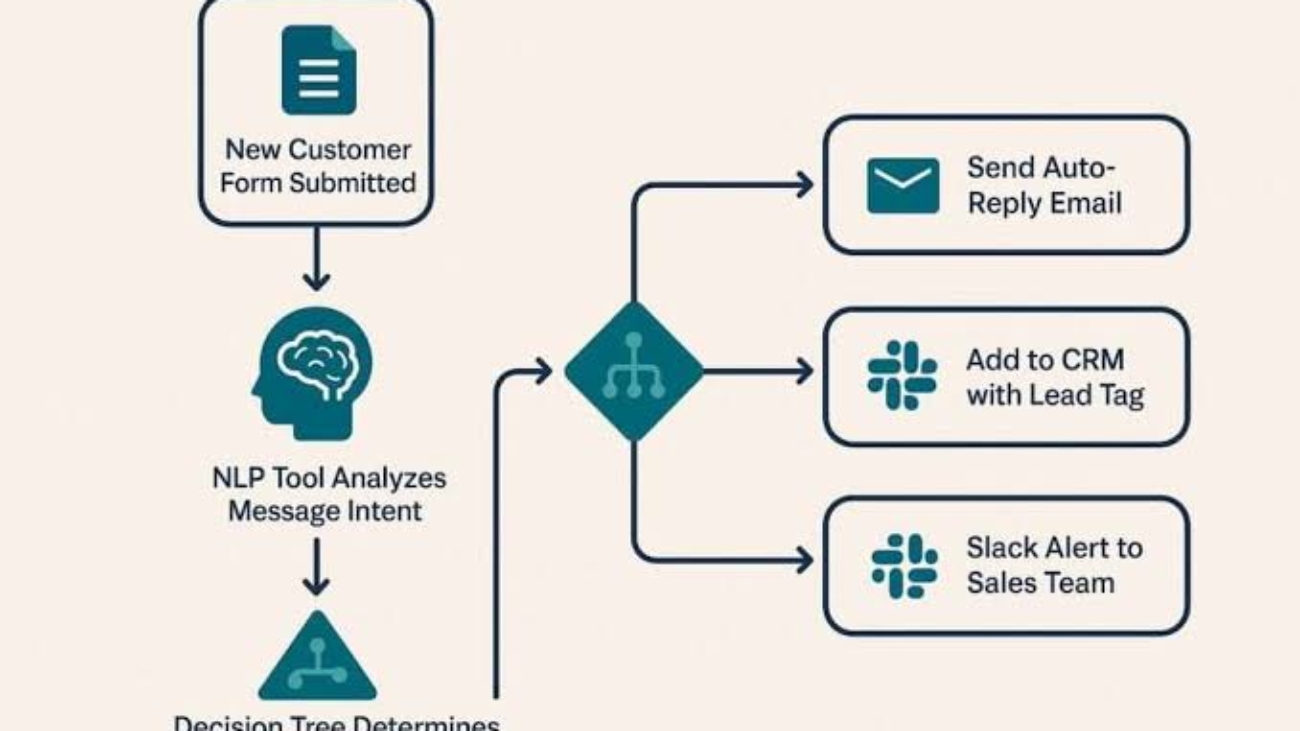
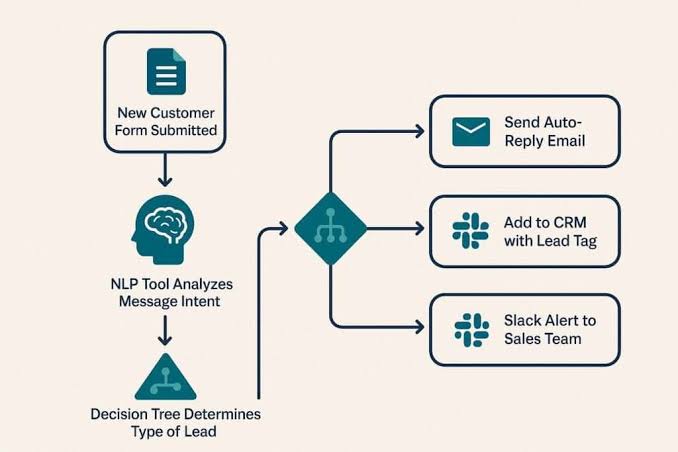
A customer submits a website form. The system organizes the information, sends a confirmation email, and notifies the business owner. A human can then review the inquiry and respond personally.

To start, learn one automation platform and build two or three demonstration projects. Show businesses how your workflow saves time, explain its limitations, and offer setup or maintenance services.

This approach can be a valuable way to make money with Make Money With AI if you enjoy solving practical problems. Test workflows carefully, protect customer information, and keep human approval for important decisions.

5. Become an AI-Assisted Social Media Manager

Businesses need regular social media content to communicate with customers and promote their services. However, planning posts and preparing creative materials can take considerable time.

You can offer a service that combines AI-assisted planning with human editing and marketing knowledge.

Your work might include content calendars, captions, post ideas, hashtag research, basic performance reports, and creative concepts.

Tools to explore: ChatGPT for brainstorming, Canva for graphics, and scheduling tools for organizing approved posts.

Start by choosing a niche, such as local shops, educational institutes, restaurants, or technology companies. Create a sample seven-day content calendar and use it to demonstrate your abilities.

You can charge for a monthly package or individual projects. Be clear about the number of posts, revisions, and reports included. Make Money With AI can support your work, but understanding the client’s audience and brand voice remains essential.

6. Build an AI-Focused Blog or Website

A blog can help you develop a long-term online business around a topic you understand. For example, a technology website can publish tutorials about AI tools, software comparisons, automation workflows, and practical digital skills.

You can use Make Money With AI to support keyword research, outline creation, proofreading, and content planning. Your experience, testing, examples, and original explanations should make the final articles valuable.

Potential income sources include:

  • Display advertising
  • Affiliate marketing
  • Sponsored articles
  • Digital product sales
  • Consulting and freelance services

Tools to explore: WordPress for publishing, Google Search Console for monitoring search performance, and AI writing assistants for research support.

Choose a specific audience and publish accurate, helpful content consistently. Optimize page titles, internal links, headings, and page speed. Search traffic usually takes time to develop, so do not expect immediate income.

7. Sell AI-Assisted Digital Products

Digital products can be created once and sold repeatedly, although they still require marketing, maintenance, and customer support.

Examples include planners, checklists, presentation templates, educational worksheets, social media calendars, and business document templates.

Make Money With AI can help you brainstorm product ideas, organize information, draft instructions, and develop product descriptions. You should carefully review every product before publishing it.

How to begin:

  1. Identify a problem people want to solve Make Money With AI.
  2. Create a simple product that addresses that problem.
  3. Test it with potential users.
  4. Select a suitable marketplace or your own website.
  5. Write a clear product description and promote it through useful content.

For instance, you could create a content-planning template for beginner bloggers or a digital checklist for small businesses.

Make sure the product offers genuine value and complies with the marketplace’s rules and the AI tool’s licensing terms.

8. Provide AI-Powered SEO Services Make Money With AI

Search engine optimization helps websites improve their visibility in organic search results. Many website owners need assistance with keyword research, content structure, metadata, internal linking, and technical checks.

AI can help organize keyword ideas, generate content briefs, suggest title variations, and explain SEO concepts.

Tools to explore: Google Search Console, Google Analytics, and AI writing assistants.

You can begin by auditing a demonstration website or your own website. Identify missing titles, confusing headings, broken links, and opportunities to improve existing content.

Then build a portfolio showing the problems you identified and the improvements you recommended.

Avoid promising guaranteed rankings or generating large amounts of low-quality content. Effective SEO requires research, technical understanding, original insights, and ongoing measurement.

9. Offer AI-Assisted Video Editing

Video content is popular across YouTube, Instagram, and other platforms. Creators and businesses often need help turning raw footage into polished videos.

Make Money With AI -assisted editing tools can help generate captions, remove pauses, transcribe speech, and identify useful clips.

Tools to explore: CapCut, Descript, and other video editors with AI features.

Possible services include short-form video editing, subtitles, educational video production, podcast clips, and promotional videos.

Create a few sample videos that demonstrate your editing skills. Contact creators or small businesses with a specific service proposal.

Always check permission to use footage, music, voices, and other creative assets. Do not imitate someone’s identity or voice without appropriate authorization.

10. Become an AI Tutor or Digital Skills Trainer

If you learn Make Money With AI AI tools well, you can teach other people how to use them productively.

Beginners may need help writing effective prompts, researching information, creating presentations, organizing tasks, or using AI responsibly in their work.

You could offer beginner workshops, one-to-one lessons, recorded tutorials, or introductory guides.

Ways to get started:

  • Select one audience, such as students, teachers, or small business owners.
  • Prepare a simple lesson plan.
  • Create practical demonstrations.
  • Publish helpful educational content.
  • Offer lessons only in areas you understand well.

Be transparent about what Make Money With AI can and cannot do. Explain how to verify important information, protect personal data, and follow applicable academic or workplace rules.

Comparison of AI Income Ideas

AI business ideaBeginner-friendly?Possible income model
Content writingYesPer article or project
Graphic designYes, with practicePer design or package
YouTube channelYes, with consistencyAds, sponsorships, products
AI automationRequires technical learningSetup and maintenance fees
Social media managementYes, with marketing skillsMonthly packages
BloggingYes, with patienceAds, affiliates, services
Digital productsYes, with product developmentPer sale
SEO servicesRequires SEO knowledgeAudits and retainers
Video editingRequires editing practicePer video or project
AI tutoringRequires subject knowledgePer lesson or workshop

These are possible business models, not guaranteed earnings. Your actual results will depend on the market, your ability, the service you provide, and the time you invest.

How to Start Making Money With AI: A Simple 30-Day Plan

You do not need to try every business idea at once. Choose one service and learn how to deliver it well.

Week 1: Learn the basics

Choose one AI tool and one service. Study its features, limitations, pricing, and terms of use.

Week 2: Build your portfolio

Create two or three original samples. For example, write a blog post, design social media graphics, or build a demonstration automation workflow.

Week 3: Find potential customers

Create a professional portfolio and contact relevant businesses or clients. Explain the problem you can solve instead of simply advertising that you use AI.

Week 4: Improve your offer

Complete a small project if you secure a client, request feedback, and improve your process. Track your time and expenses to understand whether the service is worthwhile.

The objective of your first month is to develop a useful skill, validate demand, and establish a repeatable process—not to assume you will earn a particular amount.

Common Mistakes to Avoid When Using AI for Income

When learning to make money with AI, avoid these common mistakes:

  • Expecting instant income: Most services and online businesses need time to attract customers.
  • Publishing unchecked content: AI can produce incorrect facts, misleading claims, and outdated information.
  • Copying other creators: Create original work and respect copyright and licensing requirements.
  • Buying unnecessary tools: Start with free plans where practical and upgrade only when needed.
  • Ignoring customer needs: Clients pay for useful outcomes, not simply for access to AI.
  • Falling for income guarantees: Be cautious of expensive courses or schemes promising effortless, guaranteed profits.
  • Neglecting privacy: Do not upload confidential client data into AI services without proper authorization and safeguards.

Conclusion

The easiest way to Make Money With AI in 2026 is to start with a service that matches your interests and develop the skills needed to deliver real value. Content writing, graphic design, social media management, video editing, SEO, and digital products are accessible starting points for many beginners.

More technical options, such as automation consulting, can offer additional opportunities after you develop the required knowledge.

Start small, build a portfolio, test whether people need your service, and improve through experience. Make Money With AI can help you work more efficiently, but your creativity, judgment, reliability, and ability to solve problems are what make your work valuable.

Explore more AI tools, technology tutorials, and practical digital skills on Srtechguide.com to continue learning and developing your online business ideas.
free tools social media creators use

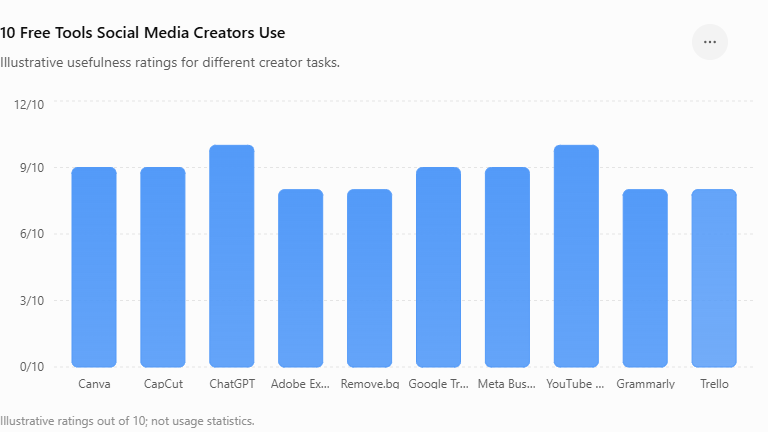
10 Free Tools Social Media Creators Use in 2026

Creating social media content consistently can be challenging. Social media creators need to plan ideas, design attractive posts, edit videos, write captions, create thumbnails, schedule content, and understand audience performance. Fortunately, many free tools social media creators use can make these tasks faster and easier.

Whether you are a YouTuber, Instagram creator, Facebook page owner, blogger, or short-video creator, the right tools can improve your workflow without requiring a large budget.

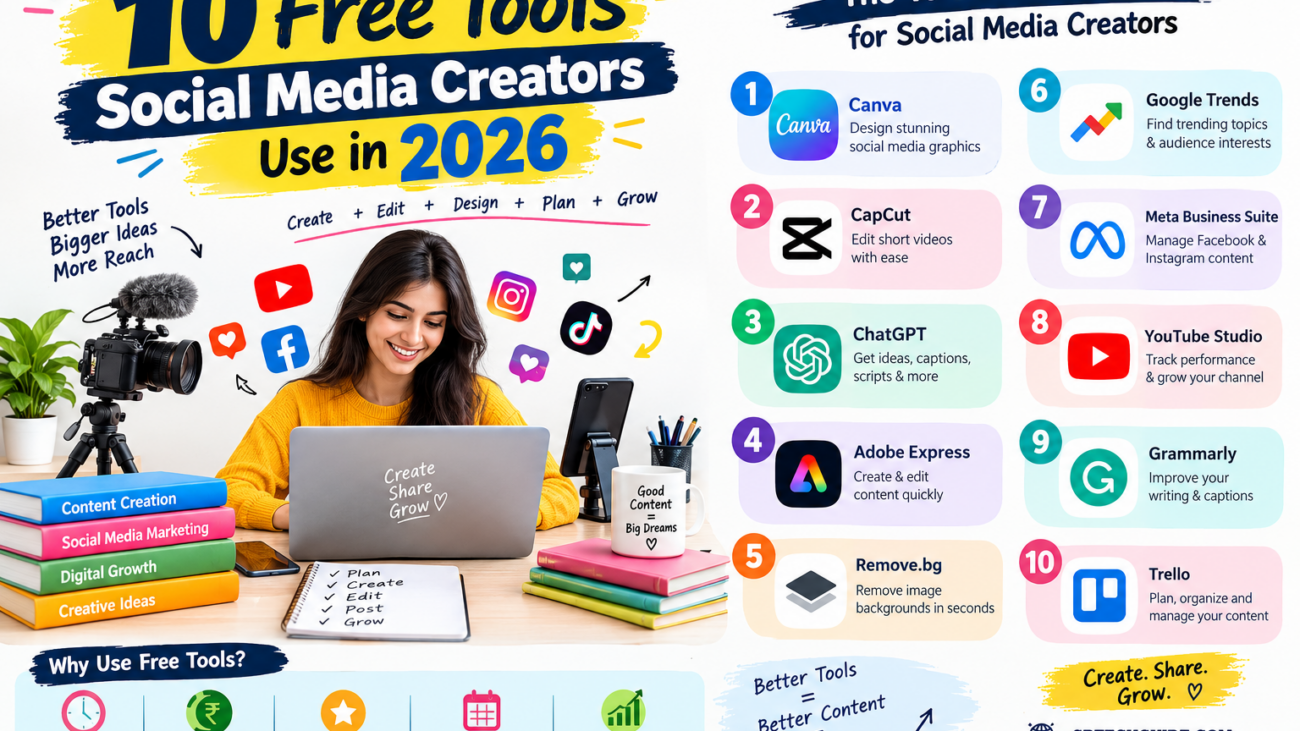
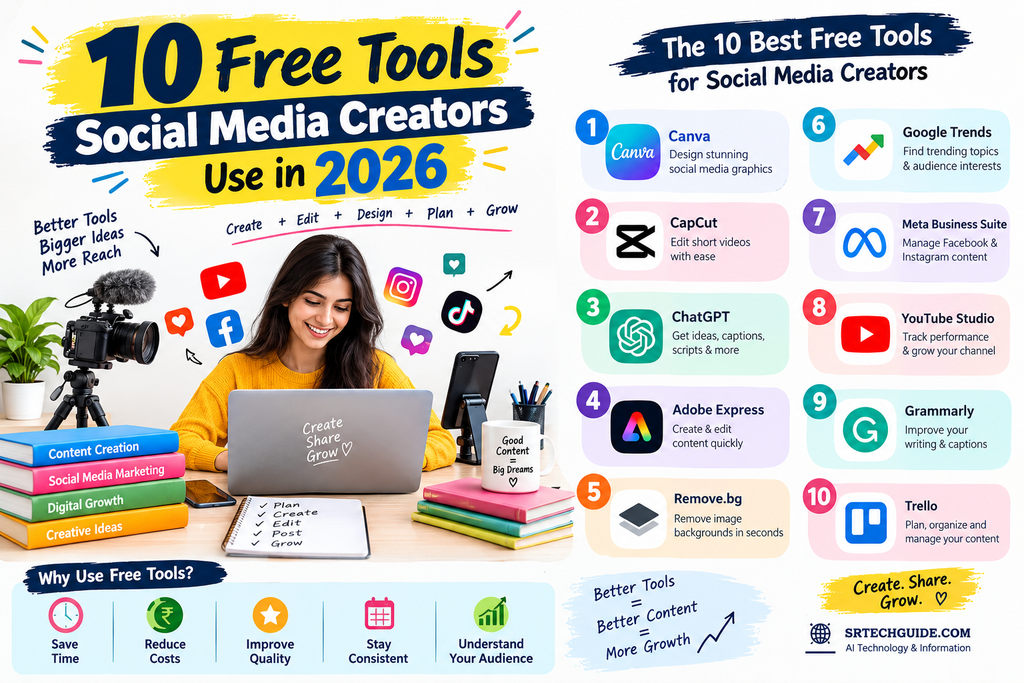
In this guide, we will explore 10 free tools social media creators use for content creation, graphic design, video editing, scheduling, analytics, writing, and productivity.

free tools social media creators use

Why Social Media Creators Need Free Tools

Social media is highly competitive. A creator may need to publish several pieces of content every week across different platforms. Doing everything manually can take a lot of time.

The best free tools social media creators use can help with:

  • Creating social media graphics
  • Editing short-form videos
  • Writing captions and content ideas
  • Removing image backgrounds
  • Creating thumbnails
  • Scheduling posts
  • Researching trends
  • Managing content
  • Tracking performance
  • Improving productivity
free tools social media creators use

Using free tools does not mean you have to compromise on quality. Many popular platforms provide useful free plans that are enough for beginners and small creators.


1. Canva – Create Social Media Graphics

Canva is one of the most popular design free tools social media creators use platforms for social media creators.

It provides templates for Instagram posts, Facebook posts, YouTube thumbnails, presentations, posters, stories, and other visual content.

What Can You Create With Canva?

  • Instagram posts
  • Facebook posts
  • YouTube thumbnails
  • Instagram Stories
  • Reels covers
  • Pinterest graphics
  • Social media banners

Canva is especially useful for creators who do not have professional graphic-design experience.

The free version free tools social media creators use provides many templates, fonts, elements, and design features.

Why creators use it: It makes professional-looking designs possible without advanced design skills.


2. CapCut – Edit Short Videos

CapCut is a popular video-editing tool for short-form content.

Social media creators can use it to edit videos for platforms such as YouTube Shorts, Instagram Reels, and TikTok.

Useful CapCut Features

  • Video trimming
  • Transitions
  • Text overlays
  • Filters
  • Effects
  • Captions
  • Music
  • Speed controls
  • Basic AI-powered editing features

For creators who primarily produce short videos, CapCut can significantly simplify the editing process.

Why creators use it: free tools social media creators use provides many beginner-friendly video-editing features in one place.


3. ChatGPT – Generate Content Ideas

OpenAI’s ChatGPT can help social media creators brainstorm and organize content.

Creators can use AI to generate ideas, create outlines, improve captions, develop hooks, and brainstorm titles.

For example, you can ask ChatGPT:

“Give me 20 Instagram Reel ideas about AI tools for beginners.”

You can also use it to create content calendars, video scripts, FAQs, and social media captions.

ChatGPT Can Help With:

  • Content ideas
  • Video scripts
  • Captions
  • Hooks
  • Titles
  • Content calendars
  • Blog outlines
  • Hashtag ideas
  • Audience questions

Why creators use it: It can reduce the time needed for brainstorming and planning.


4. Adobe Express – Quick Content Design

Adobe offers Adobe Express, a simple tool for creating social media content.

It provides templates and editing features free tools social media creators use that creators can use to produce graphics, videos, flyers, and promotional content.

Adobe Express can be useful when you want to quickly resize or redesign content for different platforms.

Best Uses

  • Social media posts
  • Promotional graphics
  • Video content
  • Posters
  • Banners
  • Simple animations

Why creators use it: It combines easy design tools with professional-looking templates.


5. Remove.bg – Remove Image Backgrounds

remove.bg is useful free tools social media creators use when you need to remove the background from an image.

For example, a creator can upload a portrait and quickly create a transparent-background image.

This can be useful for:

  • YouTube thumbnails
  • Product posts
  • Profile graphics
  • Promotional images
  • Social media designs

Instead of manually selecting a person or object in an image-editing program, background removal can be completed much faster.

Why creators use it: It saves time when preparing images for social media designs.


6. Google Trends – Find Popular Topics

Google Trends helps creators understand what people are searching for.

Before creating content, you can research whether a topic is becoming more popular or losing interest.

For example, free tools social media creators use creator can compare searches for different AI topics and identify which subjects are receiving more interest.

Google Trends Can Help You:

  • Discover trending topics
  • Compare keywords
  • Research seasonal trends
  • Find content opportunities
  • Understand search interest

Why creators use it: Good content starts with understanding what the audience is interested in.


7. Meta Business Suite – Manage Facebook and Instagram

Meta Platforms provides free tools social media creators use Meta Business Suite for managing Facebook and Instagram content.

Creators and page owners can use it to organize posts, manage messages, and review performance information.

Useful Features

  • Schedule posts
  • Manage Facebook content
  • Manage Instagram content
  • Review insights
  • Respond to messages
  • Manage comments

For creators who manage Facebook Pages or Instagram professional accounts, this can make content management more organized.

Why creators use it: It brings important Facebook and Instagram management features together.


8. YouTube Studio – Manage YouTube Content

YouTube Studio is essential for free tools social media creators use YouTube creators.

It provides information about videos, audience behavior, views, engagement, and other channel performance metrics.

Creators can use YouTube Studio to:

  • Upload videos
  • Manage videos
  • Check analytics
  • Read comments
  • Monitor channel performance
  • Review audience information
  • Manage thumbnails and video details

Analytics can help creators understand which videos are performing well and where improvements may be needed.

Why creators use it: It provides important tools for managing and understanding a YouTube channel.


9. Grammarly – Improve Social Media Writing

Grammarly can help creators improve written content.

Social media creators frequently write captions, emails, descriptions, posts, scripts, and promotional messages. free tools social media creators use Grammar and spelling mistakes can make content look less professional.

Grammarly can help identify common writing issues and suggest improvements.

Useful For:

  • Social media captions
  • YouTube descriptions
  • Blog posts
  • Emails
  • Marketing copy
  • Content drafts

Why creators use it: Better writing can make social media communication clearer and more professional.


10. Trello – Organize Content Ideas

Trello is a visual productivity and project-management tool.

Creators can use boards, lists, and cards to organize their content workflow.

For example, you can create columns such as:

Ideas → Script → Recording → Editing → Scheduled → Published

This makes it easier to understand what needs to be done next.

Trello Can Help With:

  • Content calendars
  • Video ideas
  • Campaign planning
  • Collaboration
  • Publishing schedules
  • Task management

Why creators use it: It keeps content ideas and production tasks organized.


Comparison of 10 Free Tools Social Media Creators Use

ToolBest ForUseful For
CanvaGraphic designPosts, thumbnails, stories
CapCutVideo editingReels, Shorts, videos
ChatGPTAI content assistanceIdeas, scripts, captions
Adobe ExpressQuick designGraphics and videos
Remove.bgBackground removalImages and thumbnails
Google TrendsTrend researchTopic discovery
Meta Business SuiteSocial managementFacebook and Instagram
YouTube StudioYouTube managementAnalytics and videos
GrammarlyWritingCaptions and descriptions
TrelloOrganizationContent planning

How to Use These Free Tools Together

The real advantage comes from combining different tools into one content workflow.

For example, a creator can start with Google Trends to discover a popular topic. Next, use ChatGPT to brainstorm content ideas and create a basic script.

After recording the video, use CapCut to edit it. Create a thumbnail or promotional graphic with Canva and remove the background from a portrait using Remove.bg if needed.

Then, use Grammarly to improve the caption or description. Organize future content in Trello and use Meta Business Suite to schedule Facebook and Instagram posts.

Finally, use YouTube Studio to monitor the performance of your YouTube content.

This workflow can help creators save time while maintaining a consistent publishing schedule.


Benefits of Using Free Tools for Social Media

Using the right free tools social media creators use can provide several advantages.

1. Save Time

Automation, templates, AI assistance, and easy editing can reduce repetitive work.

2. Reduce Costs

Beginners can create content without immediately investing in expensive software.

3. Improve Content Quality

Design and editing tools can make posts look more professional.

4. Stay Consistent

Planning tools can help creators maintain a regular publishing schedule.

5. Understand Your Audience

Trend and analytics tools can provide useful information about content performance.


Tips for Social Media Creators

Tools are helpful, but your strategy matters too. Consider these tips:

Know your audience: Create content that solves problems or answers questions your audience actually has.

Create consistently: A realistic publishing schedule is better than creating content randomly.

Test different formats: Try videos, carousels, images, Stories, and educational posts.

Study analytics: Look at which topics and formats generate the strongest engagement.

Improve gradually: You do not need expensive equipment or software to start.

Repurpose content: Turn one long video into multiple Shorts, Reels, posts, quotes, or educational graphics.


Final Thoughts

The right tools can make social media content creation much easier. From designing graphics with Canva to editing videos with CapCut, generating ideas with ChatGPT, researching trends with Google Trends, and managing content with Trello, creators have many useful options available.

The 10 free tools social media creators use in this guide can help with different stages of the content-creation process. You do not need to use every tool. Start with the tools that solve your biggest challenges and gradually build your own workflow.

Remember, tools are only part of successful social media growth. Creativity, consistency, audience understanding, and valuable content are equally important.

If you use these tools strategically, you can save time, improve your workflow, and spend more energy creating content that your audience wants to watch, read, and share.

free ChatGPT AI commands

Free 10 ChatGPT AI Commands and Tools YouTubers Use

Creating YouTube content takes time. You need to find ideas, write scripts, create titles, research keywords, prepare descriptions, generate social media posts, and keep your audience engaged. Fortunately, free ChatGPT AI commands can help YouTubers complete many of these tasks faster.

ChatGPT can work like a personal content assistant when you give it clear instructions. Instead of simply asking ChatGPT to “write a YouTube script,” you can use specific commands that tell it what topic to cover, who the audience is, what tone to use, and how long the content should be.

In this guide, we will explore 10 free ChatGPT AI commands that YouTubers can use for content creation, YouTube SEO, video ideas, scripts, titles, descriptions, thumbnails, and audience engagement.

free ChatGPT AI commands

What Are Free ChatGPT AI Commands?

Free ChatGPT AI commands are carefully written prompts or instructions that tell ChatGPT exactly what you want it to create.

For example, instead of writing:

“Give me a YouTube idea.”

You can use a more detailed free ChatGPT AI commands command:

“Give me 10 YouTube video ideas about AI tools for beginners. Make the ideas useful, searchable, and suitable for a technology channel.”

The second command gives ChatGPT more information, so the response can be more useful.

YouTubers can use free ChatGPT AI commands at almost every stage of the content creation process.

Why YouTubers Use ChatGPT AI

YouTube creators often spend hours researching and preparing content. AI can reduce the time required for repetitive tasks and help creators organize their ideas.

Some common uses include:

  • Finding video ideas
  • Writing video scripts
  • Creating YouTube titles
  • Writing descriptions
  • Generating keywords
  • Creating hooks
  • Preparing FAQs
  • Writing social media posts
  • Brainstorming thumbnail text
  • Creating content calendars

The important thing is thatfree ChatGPT AI commands should support your creativity rather than completely replace it. Always review AI-generated content and add your own experience, examples, opinions, and personality.

10 Free ChatGPT AI Commands YouTubers Can Use

1. YouTube Video Idea Command

The first step free ChatGPT AI commands in creating a successful video is finding a good topic.

Use this command:

Command:

“Act as a YouTube content strategist. Give me 10 video ideas about [YOUR TOPIC] for beginners. Make each idea interesting, useful, and suitable for YouTube search. Include a suggested title and the main audience for each video.”

This is one of the most useful free ChatGPT AI commands for creators who regularly struggle to find fresh topics.

For example, an AI channel could ask for ideas about ChatGPT, AI tools, automation, or digital marketing.

Why use it?

It helps you create a list of possible topics instead of starting from zero every time.


2. YouTube Script Writing Command

After choosing a topic, you need a strong script.

Try this:

Command:

“Write a YouTube video script about [TOPIC] for beginners. Start with a powerful 10-second hook, explain the topic in simple language, include practical examples, and finish with a clear call to action. Keep the tone friendly and engaging.”

This free ChatGPT AI command can create a starting structure for your video.

You can then add your own examples and experiences to make the script original.

Recommended structure

  1. Hook
  2. Introduction
  3. Problem
  4. Main explanation
  5. Examples
  6. Tips
  7. Conclusion
  8. Call to action

3. YouTube Title Command

Your title is important because viewers need to understand what your video offers.

Use this command:

Command:

“Generate 15 YouTube titles for a video about [TOPIC]. Make them clear, interesting, and SEO-friendly. Avoid misleading clickbait. Keep the titles concise and suitable for a beginner audience.”

This free ChatGPT AI command can give you multiple title ideas.

For example, instead of using a generic title such as:

“ChatGPT Tutorial”

you could explore variations such as:

“10 ChatGPT Commands Every YouTuber Should Know”

The final title should accurately represent the video.


4. YouTube Description Command

Writing descriptions for every video can become repetitive.

Use this command:

Command:

“Write an SEO-friendly YouTube description for my video about [TOPIC]. Include a short introduction, important points covered in the video, relevant keywords naturally, a call to action, and a short disclaimer if needed.”

A good description helps viewers understand what they will learn from your video.

You can also ask ChatGPT to create timestamps based on your final script.


5. YouTube Keyword Command

Keywords can help you understand what phrases are relevant to your video topic.

Try:

Command:

“Give me 20 relevant YouTube keyword ideas for a video about [TOPIC]. Group them into primary keywords, secondary keywords, long-tail keywords, and question-based keywords.”

This free ChatGPT AI command can help you brainstorm search phrases.

However, do not blindly add every keyword to your title or description. Keywords should be relevant and used naturally.


6. YouTube Hook Command

The opening seconds of a video are extremely important for getting viewers interested.

Use:

Command:

“Write 10 powerful YouTube video hooks for a video about [TOPIC]. Each hook should create curiosity, clearly communicate the benefit, and be understandable within 10 seconds.”

For example, your hook could introduce a problem:

“Are you spending hours creating YouTube content? These AI commands can help you organize your workflow much faster.”

A good hook should quickly tell viewers why they should continue watching.


7. Thumbnail Text Command

ChatGPT can also help brainstorm short thumbnail phrases.

Use:

Command:

“Give me 15 short thumbnail text ideas for a YouTube video about [TOPIC]. Keep each option between 2 and 5 words. Make them easy to read and different from the video title.”

Examples could include:

  • 10 AI Commands
  • Create Videos Faster
  • YouTube AI Secrets
  • Work Smarter With AI
  • Free AI Tools

Keep thumbnail text short. The thumbnail should communicate the idea quickly.


8. YouTube Shorts Command

YouTubers can use AI to repurpose long-form content into Shorts.

Try this command:

Command:

“Turn this YouTube video topic into 5 YouTube Shorts ideas. For each Short, create a strong opening hook, 30–60 second script, key takeaway, and call to action.”

This is another useful free ChatGPT AI command for creators who want to create both long-form videos and Shorts.

For example, one 10-minute video about AI tools could become several short videos covering individual tools or tips.


9. Audience Engagement Command

Building an audience requires communication.

Use:Command:

“Create 20 engaging questions that I can ask my YouTube audience about [TOPI]. Make the questions suitable for comments and encourage viewers to share their experiences or opinions.”

You can use these questions at the end of videos, in Community posts, or as discussion starters.https://www.youtube.com/watch?v=2IAYFgAqX6g

For example:

“Which AI tool saves you the most time every week?”

Questions like this can encourage viewers to participate.


10. YouTube Content Calendar Command

Consistency is easier when you have a plan.

Use:

Command:

“Create a 30-day YouTube content calendar for a channel about [TOPIC]. Include the video title, content type, target audience, main keyword idea, suggested hook, and call-to-action for every day.”

This free ChatGPT AI command can help organize your content workflow.

Instead of deciding what to publish every day, you can prepare your ideas in advance and adjust the calendar according to your audience’s interests.

How to Use ChatGPT Commands Effectively

Using AI does not mean copying everything it generates. The quality of your results depends heavily on the quality of your instructions.

A useful command should provide:

1. Role

Tell ChatGPT what role it should take.

Example:

“Act as a YouTube SEO strategist.”

2. Topic

Clearly explain your subject.

Example:

“My topic is free AI tools for students.”

3. Audience

Tell it who will watch your content.

Example:

“My audience is beginners and college students.”

4. Format

Explain what you want.

Example:

“Create a 60-second YouTube Shorts script.”

5. Tone

Specify the style.

Example:

“Use a friendly, simple, and educational tone.”

Combining these elements makes free ChatGPT AI commands much more effective.

free ChatGPT AI commands vs Manual Content Creation

TaskManual WorkWith ChatGPT
Video ideasBrainstormingIdea generation
Script outlineManual researchFast structure
TitlesMultiple draftsTitle variations
DescriptionWrite from scratchFirst draft
HooksBrainstormingMultiple options
Shorts ideasManual repurposingQuick concepts
Content calendarSpreadsheet planningStructured ideas
Audience questionsManual creationMultiple questions

AI can save time, but human judgment is still important.

Tips for YouTubers Using Free ChatGPT AI Commands

Add Your Own Experience

AI-generated free ChatGPT AI commands content can sound generic. Add your personal examples, opinions, demonstrations, and results.

Fact-Check Important Information

Do not automatically assume every AI-generated statement is correct. Check important facts, statistics, product information, and current information before publishing.

Avoid Repetitive Content

Using the same command repeatedly can produce similar-looking content. Change your instructions and add unique information.

Focus on the Viewer

Ask yourself:

“What will the viewer learn or gain from this video?”

Useful content is more valuable than simply producing a large amount of AI-generated text.

Improve Your Commands Over Time

Save commands that produce good results and improve them based on your experience.

Final Thoughts

Free ChatGPT AI commands can be powerful assistants for YouTubers. They can help with video ideas, scripts, titles, descriptions, hooks, keywords, thumbnails, Shorts, audience questions, and content calendars.

The biggest advantage is not simply generating content faster. It is creating a more organized workflow so you can spend more time recording, editing, experimenting, and connecting with your audience.

Start with the 10 commands in this guide and customize them for your own YouTube niche. Whether you create technology videos, educational content, gaming videos, tutorials, reviews, or Shorts, the right free ChatGPT AI commands can help you turn ideas into a repeatable content workflow.

Remember: AI is a tool, not a replacement for your creativity. Your experience, knowledge, personality, and original ideas are what make your YouTube channel unique.

Search Engine Optimization (SEO)

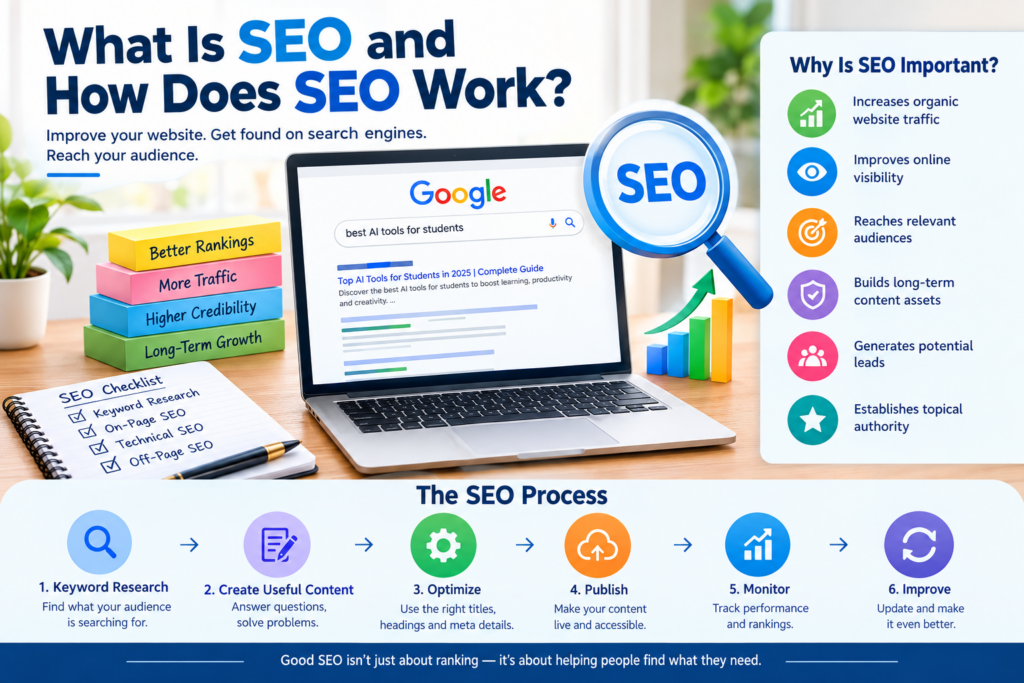
What Is Search Engine Optimization (SEO) and How Does SEO Work?

Search Engine Optimization (SEO), is the process of improving a website so that it can appear more prominently in search engine results such as Google and Bing.

When people search for something online, search engines analyze thousands of pages to determine which results are most relevant and useful.Search Engine Optimization (SEO) helps search engines understand your website and helps users find your content.

Why Numbers Improve Your SEO Title

  • Higher Click-Through Rates (CTR): Titles with numbers stand out visually in crowded Search Engine Result Pages (SERPs), drawing more clicks.
  • Sets Clear Expectations: Numbers tell the user exactly what to expect, making the content feel digestible and actionable.
  • Signals Freshness: Adding current years (e.g., “2026 Guide”) reassures search engines and users that the information is up to date.
Search Engine Optimization (SEO)

How Does Search Engine Optimization (SEO) Work?

Search Engine Optimization (SEO) involves several important areas:

Search Engine Optimization (SEO) is essential for increasing online visibility and connecting websites with the right audience. Moving beyond simple keyword stuffing, modern SEO focuses on delivering genuine value through clear structure, fast technical performance, and authentic search intent.

A successful strategy rests on four key pillars:

  • Keyword Research: Understanding what users search for and why.
  • On-Page SEO: Crafting helpful content with optimized titles and headings.
  • Technical SEO: Ensuring fast loading speeds, mobile-friendliness, and clean site architecture.
  • Off-Page SEO: Earning trustworthy backlinks to build site authority.

Rather than looking for quick shortcuts, sustainable digital growth requires a long-term commitment to quality. Search engines reward websites that prioritize the user experience, offer clear and original information, and maintain a strong technical foundation. When you consistently answer user questions effectively and keep your site accessible, organic traffic grows naturally, transforming casual visitors into loyal readers and long-term customers.

1. Keyword Research Search Engine Optimization (SEO)

Keywords are the words and phrases people type into search engines.

For example, if you have an AI technology website, potential keywords could include:

  • AI tools
  • Best AI tools
  • AI automation
  • Free AI tools
  • AI tools for business
  • AI tools for students

The goal isn’t simply to use a keyword repeatedly. You should understand the search intent Search Engine Optimization (SEO) behind the keyword and create content that genuinely answers the user’s question.

2. On-Page SEO

On-page Search Engine Optimization (SEO)focuses on elements that you can control directly on your website.

Important elements include:

  • SEO-friendly page titles
  • Meta descriptions
  • H1, H2, and H3 headings
  • Relevant keywords
  • Helpful and original content
  • Internal links
  • Image alt text
  • Easy-to-read page structure

For example, instead of writing a page with a generic title such as “Our Blog,” you could use a more descriptive title such as “AI Tools, Automation & Technology Guides.”

3. Technical SEO

Technical Search Engine Optimization (SEO) helps search engines crawl and understand your website.

Some common technical SEO factors include:

  • Website loading speed
  • Mobile friendliness
  • HTTPS security
  • XML sitemap
  • Proper URL structure
  • Crawlability
  • Fixing broken links
  • Structured data where appropriate

A website can have excellent content, but technical problems can make it harder for search engines and Search Engine Optimization (SEO) users to access that content.

4. Off-Page SEO

Off-page Search Engine Optimization (SEO) involves activities outside your website that can contribute to your site’s visibility and reputation.

One important example is earning quality backlinks from relevant and trustworthy websites.

However, getting hundreds of low-quality or spammy links isn’t a good Search Engine Optimization (SEO) strategy. The focus should be on creating useful content that other websites have a genuine reason to reference.

Why Is SEO Important?

Search Engine Optimization (SEO) can help a website attract people who are actively searching for information, products, or services related to its topic.Search Engine Optimization (SEO) has evolved far beyond traditional keyword placement. In today’s digital ecosystem, search engines and conversational AI systems prioritize genuine trust, comprehensive topical depth, and structured clarity over repetitive text. Modern optimization requires an integrated approach that satisfies both human readers and sophisticated crawling algorithms.

For example, someone searching for “best AI tools for students” already has a specific interest. A well-optimized article that provides useful information can potentially reach that audience through organic search.

SEO can also help businesses:

  • Increase organic website traffic
  • Improve online visibility
  • Reach relevant audiences
  • Build long-term content assets
  • Generate potential leads
  • Establish topical authority

How Long Does Search Engine Optimization (SEO) Take?

Search Engine Optimization (SEO) usually isn’t an overnight strategy.

The time required can vary depending on factors such as website age, competition, content quality, technical SEO, backlinks, search intent, and the topic being targeted.

Instead of expecting immediate results, it’s better to think of SEO as a long-term process:

Combine numbers and power words to construct high-performing title tags:

Generic TitlePower Word & Number UpgradeKey Impact
SEO Guide for Beginners7 Essential SEO Tips for Beginners in 2026Creates urgency and essential value
How to Improve Website Ranking10 Proven Strategies to Skyrocket Your Google RankingSignals high reliability and dramatic results
Understanding Search OptimizationThe Ultimate SEO Checklist: 5 Crucial StepsPositions as the definitive, single-source solution

Research → Create useful content → Optimize → Publish → Monitor → Improve

Common Search Engine Optimization (SEO) Mistakes to Avoid

Some common mistakes include:

  1. Keyword stuffing
  2. Publishing thin or low-value content
  3. Copying content from other websites
  4. Ignoring mobile users
  5. Using misleading titles
  6. Building poor-quality backlinks
  7. Ignoring technical SEO
  8. Writing only for search engines instead of people

One of the biggest mistakes is focusing too much on keyword density. Keywords are important, but repeating the same phrase unnecessarily can make content difficult to read.At its core, a successful strategy relies on four foundational pillars: keyword research driven by authentic search intent, clean on-page structure, robust technical performance, and off-page authority built through credible references. Rather than chasing arbitrary keyword density targets, contemporary optimization focuses on creating valuable, original content that directly answers user questions.

What Is the Best Search Engine Optimization (SEO) Strategy?

There isn’t one single SEO technique that works for every website.

A practical Search Engine Optimization (SEO) strategy starts with understanding your audience and their search intent. Then create genuinely useful content, make the website technically accessible, optimize important on-page elements, build relevant authority, and regularly analyze performance.Furthermore, the rise of AI-driven search overviews means visibility is no longer just about securing a traditional blue link. Brands must focus on establishing strong E-E-A-T (Experience, Expertise, Authoritativeness, and Trustworthiness) signals, ensuring their pages are structured clearly enough to be cited as trusted reference points by AI assistants. Technical factors like mobile usability, fast loading speeds, and clean XML sitemaps remain critical for ensuring smooth indexing.

For a new website, I would start with:

1. Find relevant topics and keywords
2. Understand what users are searching for
3. Create better and more useful content
4. Optimize titles, headings, URLs, and images
5. Improve website speed and mobile usability
6. Add internal links between related pages
7. Promote useful content and earn relevant backlinks
8. Track performance and update older content

Search Engine Optimization (SEO) is not just about getting a website to rank. The real objective should be to help users find the information they need quickly and easilyUltimately, sustainable digital growth comes from treating optimization as a long-term commitment to quality rather than a quick shortcut. By consistently prioritizing user needs, maintaining technical health, and building real authority, websites can secure long-term organic visibility and foster deep audience trust.

If you consistently create useful content and build a technically sound website, Search Engine Optimization (SEO) can become an important source of long-term organic traffic.

AI email marketing automation

AI Email Marketing Automation: Tools, Workflows & Real-World Use Cases

Small businesses often operate with limited employees, budgets, and time. Repetitive tasks such as responding to customer emails, following up with leads, scheduling appointments, creating content, updating customer records, and sending marketing campaigns can consume valuable working hours. This is where artificial intelligence and automation can make a significant difference.

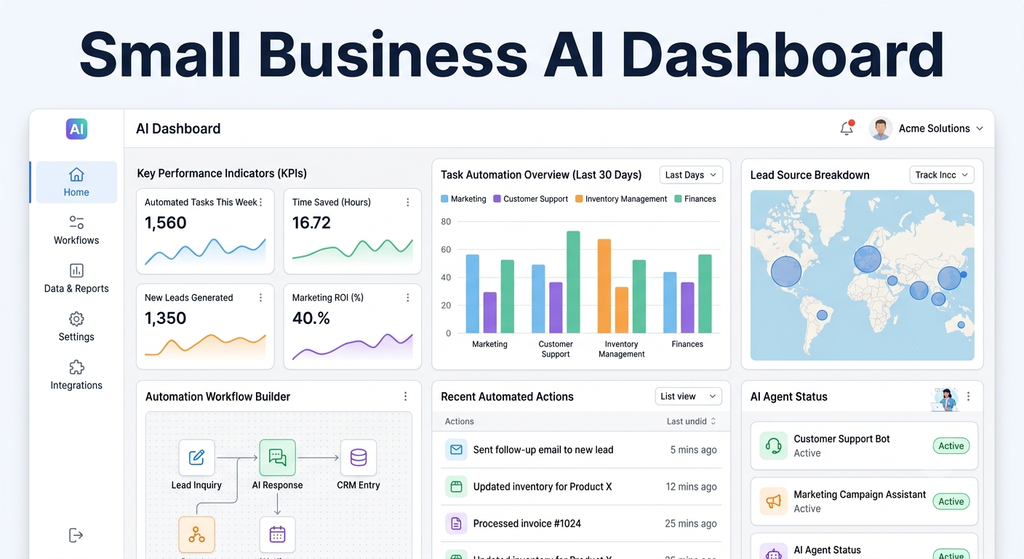
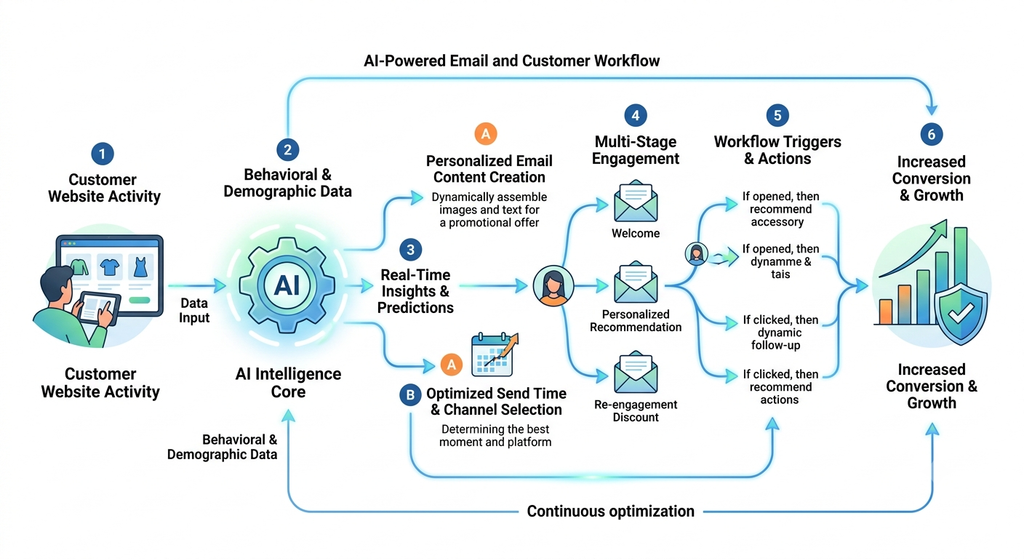
One particularly useful application is AI email marketing automation, which can help businesses organize customer communication, personalize campaigns, schedule messages, and automate follow-ups. Instead of manually sending every email, businesses can create workflows that respond to customer actions and predefined conditions.

Modern AI email marketing automation combines traditional marketing automation with artificial intelligence. AI can analyze customer interactions, help generate email content, identify patterns, and support personalized communication. When implemented correctly, these systems allow small teams to handle more marketing activities without increasing their workload at the same rate.

This guide explores practical AI automation tools, workflows, and real-world use cases that small businesses can consider.

AI email marketing automation

H2: What Is AI Automation for Small Businesses?

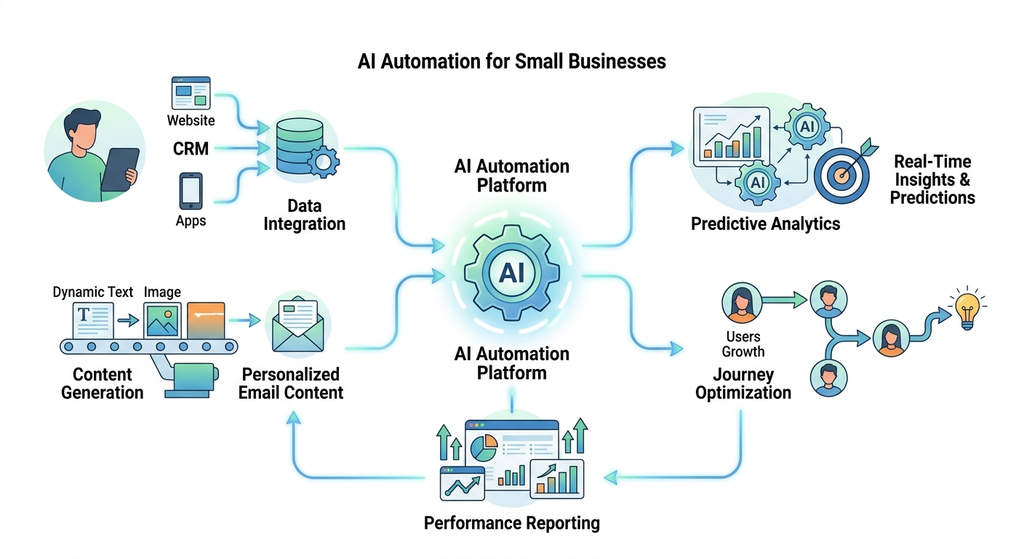
AI automation means using artificial intelligence together with software workflows to complete repetitive or information-heavy business tasks. Traditional automation generally follows fixed rules, while AI-powered systems can work with language, patterns, predictions, and large amounts of information.

For example, a traditional workflow might send the same email to every new subscriber. With AI email marketing automation, the system can help personalize the message based on available customer information, previous interactions, interests, or behavior.

Small businesses can use AI automation for:

  • Customer support
  • Marketing
  • Email campaigns
  • Lead management
  • Appointment scheduling
  • Data entry
  • Content creation
  • Social media management
  • Sales follow-ups
  • Reporting and analytics
  • Internal business workflows

The objective is not necessarily to automate every activity. Instead, businesses should identify repetitive processes where automation can save time while maintaining quality and appropriate human oversight.

H2: Why AI email marketing automation Matters for Small Businesses

Large companies may have dedicated marketing, sales, customer service, and technology teams. Small businesses frequently have employees managing several responsibilities simultaneously.

AI automation can reduce repetitive work and allow employees to concentrate on activities requiring creativity, communication, strategy, and judgment.

For marketing teams, AI email marketing automation can be particularly valuable because email campaigns often involve several repetitive steps. A business may need to segment contacts, create messages, schedule campaigns, monitor engagement, and send follow-ups.

An automated workflow can connect these activities. For example:

Customer signs up → contact is added to the database → welcome email is sent → engagement is monitored → follow-up message is triggered → interested customer is sent to sales.

With AI email marketing automation, AI can also assist with subject-line ideas, content variations, audience segmentation, and campaign analysis.

AI email marketing automation

H2: Essential AI email marketing automation Tools for Small Businesses

Small businesses do not necessarily need dozens of applications. A practical technology stack can combine a CRM, automation platform, email marketing system, AI assistant, and analytics tools.

H3: 1. AI-Powered Email Marketing Platforms

Email marketing platforms can help businesses create campaigns, manage subscribers, build customer journeys, and analyze campaign performance.

AI email marketing automation features may assist with personalization, content suggestions, audience segmentation, send-time optimization, and automated customer journeys.

For example, an online store could create a workflow that sends a welcome message to new subscribers, educational content to engaged customers, and a reminder to customers who have interacted with products but have not completed a purchase.

H3: 2. CRM and Sales AI email marketing automation

Customer relationship management platforms store information about leads and customers. Automation can then trigger actions based on changes in customer records.

A lead completing a contact form could automatically receive an introductory email. The sales team could receive a notification, and the lead could be assigned to an appropriate pipeline.

When combined with AI email marketing automation, CRM data can support more relevant customer communication.

H3: 3. Workflow Automation Platforms

Workflow automation platforms connect different applications. For example, a business could connect its website form, CRM, email platform, spreadsheet, and notification system.

A typical workflow might look like:

Website form → CRM → AI processing → email platform → sales notification → reporting dashboard.

This approach allows small businesses to create connected processes instead of repeatedly transferring information between applications.

H3: 4. AI Writing Assistants

AI writing assistants can help draft marketing emails, blog introductions, product descriptions, social posts, and customer communication.

For AI email marketing automation, an AI writing assistant can help create several versions of a message for different customer segments. Human review should still be used to check accuracy, tone, brand guidelines, and important claims before publication.

H3: 5. AI Analytics Tools

Analytics tools help businesses understand what is happening across their marketing and sales activities.

AI-powered analytics can identify patterns in customer behavior and campaign performance. These insights can help businesses determine which workflows deserve improvement.

For example, if customers consistently open educational emails but rarely respond to sales messages, the business could reconsider its customer journey and timing.

H2: Building an AI Automation Workflow

Before implementing AI email marketing automation, small businesses should map the existing process.

Start by identifying a repetitive task that happens frequently. Then document the steps involved and determine which steps require human judgment.

A simple implementation process includes:

  1. Identify a repetitive business task.
  2. Define the desired outcome.
  3. Map the current workflow.
  4. Select suitable automation tools.
  5. Connect the required applications.
  6. Create automation rules.
  7. Add AI where it provides genuine value.
  8. Test the workflow.
  9. Monitor results.
  10. Improve the workflow over time.

For example, a small consulting company could automate its lead nurturing process.

A visitor completes a consultation form. The information enters the CRM. AI email marketing automation then triggers a personalized introductory email. If the person engages with the email, a second educational message can be sent. If the lead requests a consultation, the sales team receives an alert.

This creates a structured customer journey without requiring an employee to manually manage every step.

AI email marketing automation

H2: Real-World Use Case: AI Email Marketing Automation

One of the clearest applications is customer email communication.

Consider a small online business with hundreds or thousands of subscribers. Manually sending personalized emails to every customer would be difficult.

With AI email marketing automation, the company can create customer segments and automated journeys.

A basic workflow could include:

New subscriber → welcome email → educational email → product information → follow-up → customer support invitation.

AI can assist with generating content variations and analyzing customer engagement. Automation handles timing and delivery.

Another workflow could focus on existing customers. After a purchase, the customer might receive an order-related message, helpful product information, and a later feedback request.

The business can then analyze the results and adjust its workflow.

H2: Real-World Use Case: Lead Generation and Follow-Up

Lead follow-up is another area where small businesses can benefit from automation.

Imagine a local service company receiving inquiries through its website. Without automation, an employee might need to manually copy each inquiry into a spreadsheet, send a response, and remember to follow up later.

An automated system can reduce these steps.

A visitor submits a form. The CRM stores the lead. AI email marketing automation sends an appropriate introductory message. The sales team receives a notification, and a follow-up workflow can be triggered according to the customer’s interaction.

This helps create a more consistent process.

H2: Real-World Use Case: E-Commerce Customer Journeys

E-commerce businesses can use AI automation throughout the customer lifecycle.

For example, a store can create workflows for:

  • New customer welcome messages
  • Product education
  • Order-related communication
  • Customer feedback
  • Product recommendations
  • Customer re-engagement
  • Promotional campaigns

AI email marketing automation can help organize these journeys around customer behavior rather than sending exactly the same communication to everyone.

The important principle is relevance. Businesses should avoid excessive messaging and ensure customers receive useful information.

H2: Real-World Use Case: Appointment-Based Businesses

Consultants, tutors, agencies, repair services, and other appointment-based businesses can automate communication around bookings.

A customer might receive an automated confirmation after scheduling an appointment. A reminder can follow later, and a post-appointment message can request feedback.

With AI email marketing automation, Maximized businesses can also organize follow-up campaigns for customers who have not booked another appointment.

For a small team, these workflows can reduce administrative powerful work while creating a more consistent customer experience.

H2: Real-World Use Case: Customer Support

AI automation can also assist customer support.

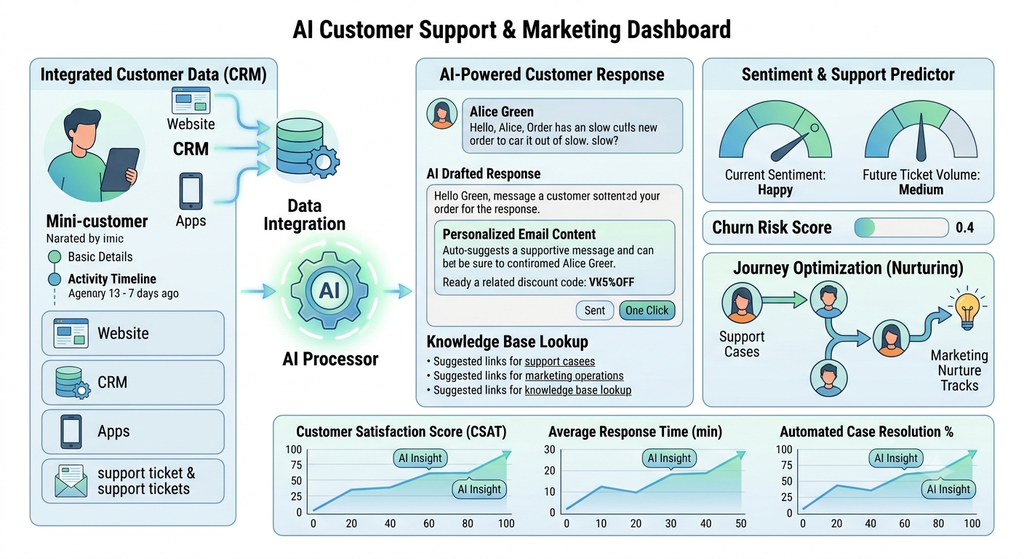
A business can create workflows that categorize incoming questions, route messages to the appropriate team, and provide automated responses for common requests.

For example, customers asking about business hours, basic policies, or order status may receive automated information, while complex issues can be forwarded to a human representative.

When AI email marketing automation is connected to customer support workflows, support interactions can also trigger relevant follow-up communication.

However, businesses should provide a clear path to human assistance when an automated response is insufficient.

H2: How AI Email Marketing Automation Improves Productivity

The major benefit of AI email marketing automation is reducing repetitive manual work.

Instead of repeatedly creating the same campaigns and manually checking customer actions, businesses can create reusable workflows.

Power Word Examples in Action

  • Catchy Headline: Supercharge Your Sales: How Small Businesses Can Scale Revenue with Instant AI Email Automation
  • Email Subject Line: Unleash 24/7 Hands-Free Email Automation for Your Business
  • High-Converting CTA Button: Unlock Your AI-Powered Email System Today
AI email marketing automation

For example, a welcome sequence only needs to be designed once. After that, the workflow can automatically handle new subscribers according to the rules established by the business.

This can help employees spend more time on strategy, customer relationships, product development, and other important activities.

Automation can also improve consistency. Every customer entering the same workflow can receive the appropriate communication without relying entirely on someone remembering to send it.

H2: Common Mistakes to Avoid

Although AI email marketing automation can be useful, poor implementation can create problems.

H3: Automating Everything

Not every task should be automated. Complex customer complaints, sensitive communication, and important business decisions may require human involvement.

H3: Sending Too Many Emails

Automation makes it easy to send messages frequently. However, more messages do not automatically mean better marketing.

Businesses should establish sensible communication limits and provide customers with appropriate subscription controls.

H3: Ignoring Data Quality

AI and automation depend on accurate information. Incorrect customer names, outdated contact information, or poorly organized segments can lead to poor communication.

H3: Skipping Human Review

AI-generated content should be reviewed before important campaigns are published. Human oversight helps maintain accuracy, brand consistency, and appropriate messaging.

H3: Choosing Too Many Tools

A complicated technology stack can create more problems than it solves. Start with a small number of tools and expand only when there is a clear business requirement.

H2: How to Measure AI Automation Success

Businesses should measure automation using meaningful performance indicators rather than simply counting the number of automated tasks.

For AI email marketing automation, useful metrics can include:

  • Email engagement
  • Click activity
  • Conversion rates
  • Lead response rates
  • Customer retention
  • Unsubscribe rates
  • Time saved
  • Revenue generated from campaigns
  • Workflow completion rates

For broader AI automation, businesses can also measure employee productivity, processing time, customer response time, and operational costs.

The exact metrics should depend on the business objective.

H2: The Future of AI Automation for Small Businesses

AI automation is becoming increasingly accessible to smaller organizations. Businesses no longer need large technology teams to experiment with intelligent workflows.

The future of AI email marketing automation is likely to involve increasingly personalized customer journeys, improved content assistance, behavioral analysis, and deeper connections between CRM, marketing, sales, and customer-support systems.

However, successful automation will still require strategy. AI should support business goals rather than become a technology experiment without a clear purpose.

Small businesses that begin with practical use cases can gradually expand their automation systems as they understand what works.

H2: Final Thoughts

AI automation can help small businesses reduce repetitive work, organize processes, and improve customer communication. Among its many applications, AI email marketing automation provides a practical way to build consistent and personalized customer journeys.

The best approach is to start small. Identify one repetitive process, define the desired result, choose appropriate tools, build the workflow, test it, and measure the outcome.

Whether a business wants to automate lead follow-ups, customer emails, appointment reminders, support communication, or marketing campaigns, AI can become a valuable part of its workflow when implemented thoughtfully.

The goal is not to replace every human task. The goal is to allow people to spend less time on repetitive processes and more time on activities where human creativity, judgment, and relationships matter.

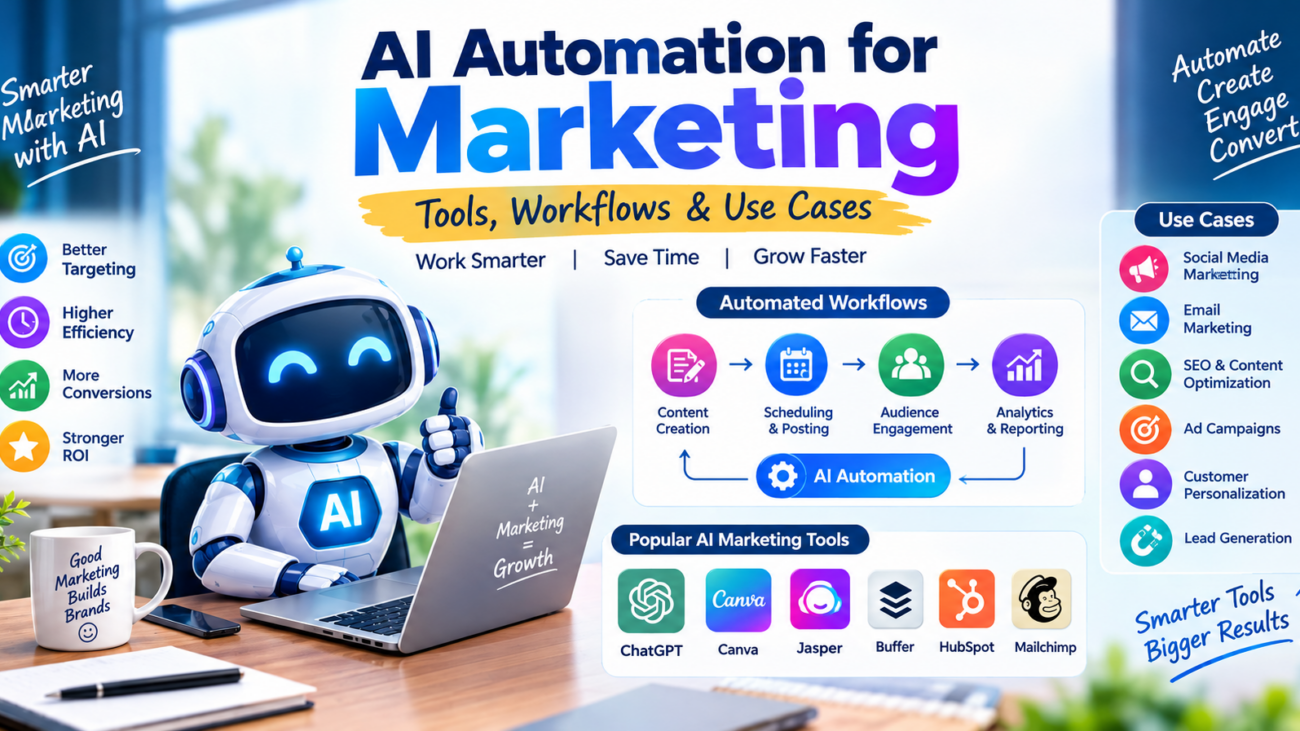
AI Automation for Marketing

AI Automation for Marketing: Tools, Workflows & Use Cases

Marketing used to be about fixed sequences: If a user opens Email A, send Email B after three days. If they didn’t, drop them into a generic re-engagement sequence.

AI Automation for Marketing combines predictive analytics, natural language processing, and machine learning algorithms with standard execution channels. Instead of executing rigid rules, AI analyzes real-time user intent, optimizes campaign parameters on the fly, and personalizes individual customer journeys at scale.

Modern marketing automation has evolved. Static decision trees are giving way to dynamic, intelligent systems capable of learning, adapting, and decision-making in real time.

This complete guide to AI Automation for Marketing breaks down the core shift from traditional to AI-driven automation, the top tools powering growth teams today, actionable step-by-step workflows, and high-impact use cases across the funnel.

AI Automation for Marketing

Traditional vs. AI-Powered Marketing Automation

Understanding the gap between rule-based logic and predictive AI helps teams deploy technology effectively:

FeatureTraditional Marketing AutomationAI-Powered Marketing Automation
Logic EngineIf-This-Then-That (IFTTT) static rulesMachine learning & predictive models
SegmentationStatic demographic lists (e.g., job title, region)Dynamic behavioral clustering (e.g., intent score, churn probability)
PersonalizationMerge tags (e.g., {{first_name}})Adaptive content, individual delivery times, & predictive recommendations
OptimizationManual A/B testing & periodic reviewsContinuous multi-arm bandit testing & real-time bid adjustments
ScalabilityHigh operational overhead to maintain complex branch pathsHigh efficiency; self-refining workflows scale automatically

AI Automation for Marketing

Building an AI marketing stack doesn’t require replacing your entire infrastructure. It involves augmenting your core foundation with specialized intelligence layers.

       +-------------------------------------------------------+
       |             INTELLIGENCE & COPILOT LAYER              |
       |     (ChatGPT, Claude, Jasper, Midjourney, Writer)     |
       +---------------------------+---------------------------+
                                   |
                                   v
+----------------------------------+----------------------------------+
|                   EXECUTION & WORKFLOW ENGINES                     |
|           (HubSpot AI, Salesforce Einstein, Make, Zapier)          |
+----------------------------------+----------------------------------+
                                   |
          +------------------------+------------------------+
          |                                                 |
          v                                                 v
+-------------------+                             +-------------------+
|  PERFORMANCE ADS  |                             | CONVERSATIONAL AI |
| (Meta Advantage+, |                             | (ManyChat, Drift, |
|   Google PMax)    |                             |   Intercom Fin)   |
+-------------------+                             +-------------------+

1. Data & Workflow Automation

AI Automation for Marketing starts with reliable data and efficient workflows. Modern marketing teams can use AI-powered systems to collect, organize, analyze, and route customer information automatically.

  • HubSpot AI & Salesforce Einstein: Embedded AI features across CRM systems that handle predictive lead scoring, opportunity insights, and deal health tracking.
  • Make.com & Zapier AI: Modern integration platforms that allow teams to inject LLM prompts directly between webhooks and databases to clean, route, and enrich prospect data automatically.

2. Content Generation & Personalization

One of the most practical applications of AI Automation for Marketing is automated content creation and personalization. AI tools can help marketers produce relevant content while maintaining consistency across multiple channels.

  • Jasper & Copy.ai: Enterprise writing platforms designed to generate content across channels while maintaining strict brand voice parameters.
  • Persado & Phrasee: AI engines dedicated to optimizing brand messaging, push notifications, and email subject lines for emotional resonance and performance.
  • Dynamic Yield / Optimizely: Experience platforms that alter landing page visuals, copy, and CTAs in real time based on referral source and site browsing behavior.

3. Paid Acquisition & Channel Optimization

AI Automation for Marketing can also support paid advertising by using automated testing, audience analysis, creative optimization, and budget allocation.

  • Google Performance Max (PMax) & Meta Advantage+: Self-optimizing ad engines that continuously shift media spend, test ad formats, and match creatives to high-converting user segments.
  • Albert.ai: Autonomous paid media management tool that analyzes consumer data to execute, test, and optimize cross-channel ad campaigns.

4. Actionable AI Marketing Workflows

Integrating AI Automation for Marketing into day-to-day operations works best when designed as clear, measurable, step-by-step systems.

Workflow 1: Dynamic Multi-Channel Lead Nurturing

Rather than dropping every web lead into the same email drip, AI Automation for Marketing can adapt messaging to individual intent signals.

[ Form Submission / Site Visit ]
               │
               ▼
[ AI Lead Scoring & Intent Analysis ]
               │
       ┌───────┴───────┐
       ▼               ▼
[ High Intent ]  [ Low Intent ]
       │               │
       │               ▼
       │     [ Dynamic Email Nurture ]
       │     (Custom send times & tailored copy)
       ▼
[ Slack/CRM Alert + Auto-Book Link ]
  1. Trigger: A prospect fills out a demo form or spends significant time on pricing pages.
  2. AI Analysis: An API call passes user activity data, including pages visited, referral path, and company size, to an LLM or predictive scoring engine.
  3. Execution:
    • High Intent (>80 score): The AI drafts a powerful & helpful personalized outreach email referencing the use case, alerts the assigned AE in Slack, and generates a personalized booking link.
    • Medium/Low Intent (<80 score): The lead enters a dynamic email nurture track where send times and content topics adjust automatically based on individual engagement patterns.

This type of AI Automation for Marketing can reduce repetitive lead-management tasks while allowing marketing and sales teams to focus on qualified opportunities.

Workflow 2: Automated Content Repurposing Engine

AI Automation for Marketing can help scale content reach without requiring marketers to manually transform every long-form asset into multiple formats.

  1. Trigger: A new podcast episode, webinar recording, or long-form blog post is published.
  2. AI Ingestion: Whisper transcribes the media, or an LLM reads the raw text script.
  3. Multi-Format Processing: A structured prompt template breaks down the core insights to produce:
    • 1 LinkedIn narrative post highlighting key takeaways.
    • 3 Twitter/X threads targeting specific pain points.
    • 1 email newsletter summary with a hook.
    • Short-form video scripts complete with timestamps and visual notes.
  4. Human Review & Dispatch: Drafts populate directly into your social scheduling queue, such as Buffer or Hootsuite, for a quick human check before going live.

This workflow demonstrates how AI Automation for Marketing can connect content production, repurposing, review, and distribution into one streamlined process.

Workflow 3: Predictive Churn Prevention

Another important AI Automation for Marketing use case is customer retention. AI can help identify behavioral changes that may indicate declining engagement.

  1. Trigger: A customer’s product usage metrics, such as logins and feature activity, dip below a set baseline over a 14-day window.
  2. Predictive Check: An AI churn model evaluates account health history, support ticket sentiment, and billing status.
  3. Automated Interventions:
    • At-Risk Account: Automatically triggers a targeted in-app message offering a tutorial or relevant case study.
    • High-Value At-Risk Account: Notifies the Account Manager in CRM with a generated summary of recent friction points and suggested win-back actions.

Workflow 4: Ad Creative Iteration Loop

With AI Automation for Marketing, teams can continuously create and test advertising variations to respond to changing audience behavior.

  1. Trigger: A high-performing ad unit experiences a drop in Click-Through Rate (CTR) over 7 days.
  2. AI Variant Generation: An AI text model generates five headline and angle variations based on the original hook, while an image generator produces complementary visual assets.
  3. Deployment: The asset combinations are added to Meta Advantage+ or Google PMax ad sets as secondary variants.
  4. Optimization: The ad platform tests variants in controlled budget pools and adjusts spend based on performance.

Core Use Cases Across the Marketing Funnel

AI Automation for Marketing can be applied across multiple stages of the customer journey, from initial attraction to customer retention.

        FUNNEL STAGE                       AI AUTOMATION USE CASE
     ┌──────────────────────┐        ┌────────────────────────────────────┐
     │ Top of Funnel        │ ────>  │ Programmatic SEO & Ad Creative     │
     │ (Attraction)         │        │ Variant Generation                 │
     └──────────────────────┘        └────────────────────────────────────┘
                 │
                 ▼
     ┌──────────────────────┐        ┌────────────────────────────────────┐
     │ Middle of Funnel     │ ────>  │ Predictive Lead Scoring &          │
     │ (Consideration)      │        │ Conversational AI Bots             │
     └──────────────────────┘        └────────────────────────────────────┘
                 │
                 ▼
     ┌──────────────────────┐        ┌────────────────────────────────────┐
     │ Bottom of Funnel     │ ────>  │ Hyper-Personalized Messaging &     │
     │ (Conversion)         │        │ Dynamic Pricing / Incentives       │
     └──────────────────────┘        └────────────────────────────────────┘
                 │
                 ▼
     ┌──────────────────────┐        ┌────────────────────────────────────┐
     │ Retention            │ ────>  │ Automated Win-back Workflows &     │
     │ (Loyalty)            │        │ Predictive Churn Analytics         │
     └──────────────────────┘        └────────────────────────────────────┘

1. Predictive Lead Scoring & Qualification

Traditional lead scoring relies on arbitrary points, such as +5 for opening an email or +10 for downloading a PDF. AI Automation for Marketing uses AI lead scoring to analyze historical and behavioral data, including company information, technology usage, and website activity, to identify patterns associated with conversions.

2. Hyper-Personalization at Scale

Modern personalization extends well beyond basic field tags. AI Automation for Marketing systems can analyze past purchase history, category preferences, and content consumption to assemble dynamic emails in real time. Individual recipients can receive different product modules, imagery, and send times based on their engagement behavior.

3. Conversational AI & Lead Capture

Static web forms can create friction during the customer journey. AI Automation for Marketing can use conversational AI to qualify visitors through natural dialogue. These systems can answer product questions using an approved knowledge base, identify buyer intent, and support sales scheduling.

4. Smart Send-Time Optimization

Instead of sending an entire list an email at the same time, AI Automation for Marketing can analyze individual engagement patterns. Automated systems can distribute messages according to historical activity and engagement signals.

Best Practices and Strategic Guardrails

Clean Your Data First: Successful AI Automation for Marketing depends heavily on the quality of the underlying data. Inaccurate CRM records, missing tags, and duplicate entries can lead to poor targeting and ineffective personalization.

Keep Humans in the Loop: Always maintain human oversight for content approvals, high-value outreach, and brand-level strategies. Let AI handle data processing, execution, and initial draft work while humans manage quality control, strategic alignment, and brand tone.

Prioritize Transparency and Privacy: Responsible AI Automation for Marketing requires clear data practices. Build automated opt-out workflows, respect applicable privacy frameworks such as GDPR and CCPA, and avoid sending sensitive customer information to public AI systems without appropriate authorization.

Start Small and Scale: Avoid attempting to automate the entire marketing funnel overnight. Select one bottleneck, such as lead-routing speed or ad creative refreshes, build an automated workflow, measure performance against a baseline, and expand iteratively.

Measure Performance: The effectiveness of AI Automation for Marketing should be evaluated using relevant metrics such as conversion rate, engagement, customer acquisition cost, lead response time, retention, and return on advertising spend.

Maintain Quality: Automation should improve marketing operations without sacrificing accuracy or customer experience. Regularly review AI-generated content, workflows, targeting rules, and campaign results to ensure they continue to meet business objectives.

Final Takeaway: AI Automation for Marketing is transforming how businesses manage data, content, lead generation, advertising, personalization, and customer retention. By combining AI capabilities with structured workflows and human oversight, marketing teams can automate repetitive processes while creating more responsive and personalized customer experiences.

best AI tools for students

The Ultimate Guide to the Best AI Tools for SEO and Website Automation

The di marketing landscape has transformed dramatically. Managing a website used to require hours of manual work—from keyword research and content drafting to technical audits and social distribution. Today, artificial intelligence has shifted web management from manual labor to automated orchestration.

Integrating AI into your workflow is no longer optional if you want to remain competitive. The best AI tools for SEO can analyze search intent in seconds, generate well-structured long-form content, optimize page speed, fix technical debt, and publish articles on schedule—all with minimal human friction.

Whether you run a tech blog, an e-commerce store, or a digital agency, this guide breaks down the Best AI tools for SEO , showing you how to scale traffic, improve search visibility, and streamline site operations.

Best AI Tools for SEO

1. Why AI and Automation Are Essential for Modern SEO

Search engines like Google have evolved to prioritize user intent, content depth, topical authority, and technical performance. Traditional SEO strategies—such as manual keyword stuffing or buying low-quality backlinks—are obsolete. Modern search engine optimization demands consistent, high-value content published alongside seamless technical performance. In today’s digital landscape, leveraging Best AI Tools for SEO has become mandatory for staying competitive.

Key Benefits of AI-Driven SEO & Automation

  • Scale Without Sacrificing Quality: Produce comprehensive articles, meta descriptions, and visual assets in a fraction of the traditional time using Best AI Tools for SEO.
  • Real-Time Data Insights: Process vast amounts of search engine data to identify content gaps and competitor weaknesses before your competitors do through modern Best AI Tools for SEO
  • Automated Site Health Maintenance: Continually monitor broken links, schema markups, and site speed bottlenecks without manually running audits every week, thanks to advanced AI SEO and website automation.
  • Higher ROI on Marketing Spend: Shift your team’s focus from repetitive administrative tasks to strategic planning and high-level creative direction powered by Best AI Tools for SEO.

Keyword research is the bedrock of search optimization. AI tools go beyond search volume metrics by analyzing context, intent clusters, and Generative Engine Optimization (GEO) compatibility. Implementing AI SEO and website automation at this stage ensures your foundational targeting is rock-solid.

2. Best AI Tools for SEO Strategy & Keyword Research

Surfer SEO

Surfer SEO is an industry-standard tool for data-driven content creation and keyword clustering. Its Content Editor analyzes top-ranking pages in real time, giving you precise recommendations for keyword frequency, structural headings, image usage, and paragraph length as part of your Best AI Tools for SEO strategy.

  • Key Features:
    • Surfer AI: Generates fully researched, SEO-optimized articles based on live SERP analysis.
    • Content Audit: Identifies quick wins on existing pages that need updates or keyword additions.
    • Topic Clusters: Automatically groups related keywords to help build topical authority.
  • Best For: Content strategists and bloggers looking to rank predictably on page one using Best AI Tools for SEO

Semrush (With AI Tools)

Semrush remains an SEO powerhouse, enhanced by AI features like the Content Marketplace, SEO Writing Assistant, and One-Click Keyword Clustering, making it a cornerstone for Best AI Tools for SEO

  • Key Features:
    • Intent Analysis: Categorizes keywords by Informational, Navigational, Commercial, and Transactional intent automatically.
    • AI Copilot: Provides personalized daily recommendations to fix ranking drops and target low-hanging keyword opportunities.
    • Automated Competitor Tracking: Tracks competitors’ rank movements and alerts you to strategic shifts.
  • Best For: All-in-one digital marketing agencies and enterprise-level websites optimizing workflows through AI SEO and website automation.

Ahrefs (AI Features)

Ahrefs has embedded AI across its site explorer, keyword generator, and content auditing suite. Its natural language prompts make deep backlink and keyword data accessible to users of all experience levels who rely on Best AI Tools for SEO

  • Key Features:
    • AI Keyword Ideas Generator: Identifies semantic keyword variations and question-based queries.
    • Automated Content Gap Analysis: Highlights exact terms your competitors rank for that your site misses.
    • Brand Authority Tracking: Tracks branded search footprints and organic visibility metrics.
  • Best For: Backlink strategy, competitive intelligence, and technical audits powered by Best AI Tools for SEO

3. Top AI Tools for Content Creation & On-Page SEO

Creating content at scale requires tools that write naturally while adhering to strict search engine guidelines. Adopting Best AI Tools for SEO streamlines this entire production pipeline.

┌─────────────────────────────────────────────────────────┐
│              Modern AI Content Pipeline                  │
├───────────────┬─────────────────────────┬───────────────┤
│    Research   │       Drafting          │ Optimization  │
│  (Semrush/    │  (Jasper/Frase/         │ (Surfer SEO/  │
│   Ahrefs)     │   ChatGPT/Claude)       │ RankMath)     │
└───────────────┴─────────────────────────┴───────────────┘

Jasper AI

Jasper is an enterprise-focused AI writing workspace designed for brand consistency, built right into modern frameworks for Best AI Tools for SEO.

  • Key Features:
    • Brand Voice Engine: Learns your exact tone, style guide, and product details to maintain brand messaging.
    • SEO Mode: Connects directly with Surfer SEO to optimize content while drafting.
    • Campaign Workflows: Turns a single article brief into social posts, email newsletters, and landing pages automatically.
  • Best For: Marketing teams and businesses scaling multi-channel content production via Best AI Tools for SEO

Frase.io

Frase streamlines the content workflow by combining research, brief creation, writing, and optimization into a single interface driven by Best AI Tools for SEO

  • Key Features:
    • Automated SERP Summaries: Analyzes top search results to build structured article outlines in under two minutes.
    • AI Content Generation: Drafts complete sections tailored to answer specific user queries found in search engine results.
    • Content Decay Tracking: Flags older articles losing traffic so you can refresh them automatically.
  • Best For: SEO freelancers and agencies managing high-volume blog publishing schedules with Best AI Tools for SEO

RankIQ

Designed specifically for bloggers and small publishers, RankIQ features a curated library of hand-selected, low-competition keywords across hundreds of niches, perfectly aligned withBest AI Tools for SEO

  • Key Features:
    • Niche Keyword Library: Displays actionable keywords with high traffic potential and low ranking difficulty.
    • AI Optimizer: Outlines exact topics and terms to cover to outperform existing search results.
    • Fast Brief Creation: Takes the guesswork out of structural headings and article length.
  • Best For: Solo bloggers, affiliate marketers, and small business owners scaling up through Best AI Tools for SEO

4. Best AI Tools for Technical SEO & Website Automation

On-page content gets users to your site; technical performance keeps them there and ensures search bots can crawl your pages effectively.

Tool NameCore FunctionalityPrimary BenefitTarget User
Rank Math AIWordPress SEO AutomationOn-page SEO, Schema generation, internal link suggestionsWordPress site owners & agencies
Lumar (DeepCrawl)Enterprise Technical AuditingAutomated website crawl health monitoringLarge scale e-commerce & enterprise sites
Zapier + AI AppsWorkflow AutomationConnects web apps to automate publishing and lead captureWebmasters, operations managers
10Web AIAI Website Builder & HostAutomated page generation, speed optimization, auto-migrationAgencies & SMB owners

Rank Math AI (WordPress)

For WordPress users, Rank Math AI serves as an automated SEO assistant directly inside the block editor, leveraging Best AI Tools for SEO for peak performance.

  • Key Features:
    • Smart Schema Generator: Automatically applies appropriate Schema Markup (Article, Product, How-To, FAQ) without coding.
    • Automated Internal Link Suggestions: Recommends relevant existing pages to link to as you write new posts.
    • Content AI Engine: Provides real-time SEO scoring, smart title generation, and alt-text suggestions.

Lumar (DeepCrawl)

Technical issues like broken redirects, slow page speeds, and indexing errors can undermine content marketing efforts. Lumar uses machine learning models to detect technical issues before they impact your rankings through Best AI Tools for SEO.

  • Key Features:
    • Proactive Monitoring: Runs automated background audits to flag site performance anomalies.
    • Log File Analysis: Tracks how search engine bots crawl your site to optimize your crawl budget.
    • SEO QA Testing: Integrates into development workflows to catch technical bugs before code updates go live.

5. End-to-End Website Automation: How to Put Your Site on Autopilot

Combining these AI tools into a unified pipeline creates an automated workflow that runs background tasks efficiently, freeing you to focus on strategy via Best AI Tools for SEO

Step 1: Automated Topic Discovery & Clustering

Use Semrush or Ahrefs to set up tracking for core industry topics. Connect search trend alerts to an automated dashboard using Zapier or Make.com. When a keyword cluster hits a predefined search volume or low-competition threshold, the system auto-generates a content brief usingBest AI Tools for SEO

Step 2: Content Generation & On-Page Optimization

Pass the content brief into Frase or Jasper AI to create an initial draft. Use Surfer SEO to review keyword density, ensure correct heading structures, and include targeted FAQs.

[Keyword Discovery] ➔ [Brief Generation via Zapier] ➔ [AI Drafting] ➔ [SEO Optimization] ➔ [Automated Publishing]

Step 3: CMS Publishing & Technical Schema

Import the finished article into WordPress or Webflow. Rank Math AI automatically configures elements via AI SEO and website automation:

  • SEO Meta Title and Description.
  • Canonical URLs and Open Graph tags for social sharing.
  • Relevant Structured Data (Schema markup).
  • Image alt tags and internal links to related content.

Step 4: Social Distribution & Syndication

Once an article goes live, automation triggers a multi-channel distribution workflow optimized by AI SEO and website automation:

  • Zapier / Make.com: Detects the new RSS feed item.
  • ChatGPT / Claude API: Generates customized social posts (LinkedIn, X/Twitter, Facebook).
  • Social Tools (Buffer/SocialPilot): Schedules and publishes social posts across your brand channels automatically.

6. Common Pitfalls to Avoid with AI SEO Automation

While AI tools streamline web management, relying on unmonitored automation can create issues. Avoid these common mistakes when deploying Best AI Tools for SEO:

1. Publishing Unedited Raw AI Output

Search engine quality guidelines emphasize E-E-A-T (Experience, Expertise, Authoritativeness, and Trustworthiness). Purely automated text often lacks real-world perspective, personal experiences, and unique insights.

  • Solution: Always apply human editorial oversight. Add custom case studies, personal insights, original graphics, or unique quotes to every AI-drafted piece generated through Best AI Tools for SEO

2. Over-Optimizing Keywords

Keyword stuffing—even using modern LSI terms—makes content feel rigid and unengaging for human readers.

  • Solution: Treat optimization scores fromBest AI Tools for SEO platforms as helpful guidelines rather than rigid rules. Prioritize readability, natural language, and clear user intent over arbitrary metric targets.

3. Neglecting Technical Debt

Automating content publishing on a slow, poorly configured server will limit your reach. Fast load times, clear site architecture, and mobile optimization remain critical foundation elements.

  • Solution: Schedule monthly technical site audits using Lumar or Ahrefs to maintain underlying site health while expanding your Best AI Tools for SEO setup.

Final Thoughts: Building a Scalable AI Web Strategy

Best AI Tools for SEO tools are not about replacing human creativity—they are about removing administrative overhead. By offloading research, formatting, technical tracking, and distribution to specialized AI applications, you can scale content production and grow search traffic efficiently.

Start by selecting one or two areas in your current workflow that take up the most time—whether that is keyword research, drafting, or social distribution. Implement dedicated solutions for Best AI Tools for SEO to streamline those steps, refine your processes, and gradually build an automated engine that supports your website growth over the long term.

AI task automation

AI Task Automation Your Daily Tasks Using AI

AI Task Automation has transformed from a futuristic concept into an essential strategy in an age defined by constant notifications, endless email threads, and never-ending to-do lists. Most professionals spend a significant portion of their workday on repetitive, low-value administrative tasks, such as managing calendars, summarizing long documents, sorting through crowded inboxes, and entering data manually.Studies suggest that professionals can spend up to 40% of their workday on repetitive administrative tasks, making automation a valuable way to save time.

Artificial intelligence is no longer just a buzzword or a luxury reserved for tech giants. Today, accessible AI tools can function as a 24/7 personal digital assistant, helping you automate routine work and potentially reclaim hours every week.

Whether you are a freelancer, small business owner, corporate professional, or student, learning how to automate daily tasks with AI can be a powerful productivity skill. By reducing repetitive work and streamlining everyday workflows, AI task automation allows you to focus more time and energy on meaningful, high-value activities.

AI Task Automation offers many positive benefits, including improved productivity, greater efficiency, time savings, convenience, accuracy, and better work-life balance. It can reduce repetitive workloads and help professionals focus on creative and valuable tasks. However, there are also some negative aspects, such as job displacement, overdependence on technology, privacy concerns, technical errors, security risks, and a lack of human interaction. Therefore, while AI task automation can make daily work faster and easier, it should be used carefully and responsibly to maximize its advantages while minimizing potential drawbacks.

AI task automation
AI task automation
AI Task Automation: A Practical Guide to Automating Daily WorkflowsAI Task Automation has become a powerful way to reduce repetitive work, improve productivity, and create more time for meaningful activities. Instead of spending hours managing emails, organizing files, scheduling meetings, entering data, or creating routine documents, professionals can use artificial intelligence to handle many of these processes automatically. However, successful automation is not about handing every responsibility to technology. The most effective approach combines AI speed and efficiency with human creativity, judgment, empathy, and decision-making.Before choosing automation tools, it is important to understand which activities should be automated, which should receive AI assistance, and which should remain completely human. A thoughtful strategy can deliver significant benefits while reducing common problems such as errors, privacy risks, unnecessary complexity, and overdependence on technology.Step 1: The Automation Audit — Identify What to OutsourceThe first step in implementing AI Task Automation is conducting an automation audit. Review your typical workday and identify activities that are repetitive, predictable, time-consuming, and based on clear rules. These tasks are generally strong candidates for automation.Not every activity should be automated. Strategic thinking, complex negotiations, creative decision-making, leadership, empathy, and relationship building often require personal involvement. Automating these responsibilities too aggressively can result in poor communication, misunderstandings, reduced trust, and inappropriate decisions.A useful way to evaluate your work is the 4-Quadrant Task Matrix.The 4-Quadrant Task MatrixQuadrant 1 — Human-Only: High-complexity activities requiring strong human judgment, such as negotiations, sensitive decisions, leadership, and deep creative work.Quadrant 2 — AI-Assisted: Activities that benefit from human judgment but can be accelerated with AI, including writing, research, strategy development, brainstorming, and ideation.Quadrant 3 — Fully Automated: Repetitive, structured, and data-driven activities such as reminders, data synchronization, scheduling, file organization, and routine follow-ups.Quadrant 4 — Delegate or Eliminate: Low-value activities that consume attention without producing meaningful results.This framework helps you implement AI Task Automation strategically rather than randomly.Fully Automate — Quadrant 3Quadrant 3 contains some of the best opportunities for AI Task Automation. These tasks usually follow predictable rules and do not require complex human judgment.Examples include:Scheduling meetingsOrganizing digital filesTracking expensesSending standard follow-up messagesUpdating spreadsheetsCreating recurring remindersMoving information between applicationsSorting routine emailsAutomating these activities can provide positive results such as faster execution, fewer manual errors, improved consistency, and valuable time savings.AI Assist and Co-Pilot — Quadrant 2Some tasks should not be completely automated because they require human judgment. Instead, use AI as a co-pilot.For example, you can use AI to create an initial email draft, summarize a research paper, organize notes, generate a content outline, or identify important information in a lengthy document. You then review and improve the output.This model combines AI efficiency with human creativity. It can reduce tedious work without eliminating the human element that makes the final result valuable.Keep Human — Quadrants 1 and 4Strategic decisions, sensitive conversations, complex negotiations, team leadership, and emotionally important communications should retain meaningful human involvement.One of the biggest mistakes in AI Task Automation is assuming that every task becomes better when automated. In reality, excessive automation can create negative consequences. Customers may feel ignored, employees may receive inappropriate messages, and important decisions may be made without sufficient context.The goal should be smarter work, not simply more automation.5 High-Impact Daily Workflows to Automate1. Communication and Email ManagementEmail is one of the easiest areas to improve with AI Task Automation. Professionals can spend a substantial amount of time reading, sorting, responding to, and following up on messages.AI tools can categorize incoming emails, identify urgent messages, summarize long conversations, and generate suggested replies. This can transform an overwhelming inbox into a more organized workspace.Useful email automation tasks include:Categorizing messages by prioritySummarizing lengthy email threadsIdentifying deadlines and action itemsDrafting responsesCreating follow-up remindersSeparating promotional messages from important communicationThe positive effects can include greater organization, improved focus, faster response times, and less administrative stress.However, automated responses can sometimes be inaccurate, overly generic, or inappropriate. Important messages should always be reviewed before they are sent.2. Calendar Management and Meeting WorkflowsCalendar management is another strong use case for AI Task Automation. Instead of repeatedly exchanging messages about availability, AI scheduling systems can identify suitable meeting times based on calendars and preferences.An automated meeting workflow can include three stages:Pre-Meeting: An AI calendar assistant coordinates schedules and identifies available time slots.Mid-Meeting: An AI note-taking tool transcribes conversations and identifies important topics.Post-Meeting: AI generates a summary, extracts action items, and distributes follow-up information.This process can reduce confusion, scheduling delays, and repetitive administrative work. Meeting assistants can also make information easier to access by converting conversations into searchable transcripts and structured notes.There are limitations. Automated transcription can misunderstand technical terms, accents, unclear speech, or overlapping conversations. Important meeting notes should therefore be checked for accuracy.3. Content Creation and Social Media ManagementContent production can become significantly faster with AI Task Automation. Whether you create reports, marketing emails, blog posts, newsletters, or social media updates, AI can assist at multiple stages.Research and OutliningAI can help organize research, identify major themes, and create structured content outlines. This can reduce the time required to move from a blank page to a workable plan.DraftingAI can generate initial drafts for routine documents, announcements, descriptions, and social posts. Human editing is still necessary to maintain originality, accuracy, tone, and brand identity.Content RepurposingA long article, webinar, podcast transcript, or video can be transformed into multiple formats. AI can create social media posts, newsletter summaries, short-form content, and key-point lists from the original material.EditingAI can identify grammar problems, improve sentence structure, simplify complicated language, and suggest clearer wording.These capabilities can improve productivity, consistency, creativity, and publishing speed. However, excessive dependence on AI may create repetitive or generic content. Human review remains essential.4. Task Management and Personal PlanningAI Task Automation can also improve personal productivity by helping manage tasks and deadlines.Modern AI-powered productivity systems can analyze task lists, estimate required time, and organize activities around available calendar slots. When priorities change, some systems can automatically rearrange lower-priority tasks.AI can also turn unstructured thoughts into actionable plans. For example, you can provide a voice note containing several ideas, and AI can organize those ideas into projects, subtasks, deadlines, and next steps.This can reduce procrastination, disorganization, and mental overload.The downside is that automated planning is not always perfect. An AI system may underestimate the time required for a complex task or prioritize an activity incorrectly. Human judgment should remain part of the planning process.5. Data Entry, Document Processing, and ResearchManual data entry and lengthy document review are often tedious and time-consuming. AI Task Automation can reduce the amount of manual effort required for these activities.AI document tools can analyze contracts, financial statements, research papers, reports, and user manuals. Instead of manually searching through every page, users can ask targeted questions and receive organized summaries.AI can also extract information from structured websites and transfer it into spreadsheets, databases, or business applications.The benefits include faster processing, improved organization, reduced repetitive work, and potentially fewer manual errors.However, AI-generated information can contain mistakes or missing details. Financial, legal, medical, or business-critical information should always be verified before action is taken.Recommended AI Automation Tool StackYou do not need dozens of applications to build an effective AI Task Automation system. A focused technology stack is usually easier to manage and maintain.CategoryRecommended ToolsBest ForAI AssistantsChatGPT, Claude, Google GeminiWriting, research, summarization, codingNo-Code AutomationZapier, Make, n8n, ActivepiecesConnecting applicationsMeeting AssistantsFireflies.ai, Otter.ai, FathomTranscription and action itemsCalendar ToolsMotion, Reclaim.ai, INotes, projects, and documentation

The objective is to build a simple, reliable, and useful system rather than creating unnecessary complexity.

How to Build Your First No-Code AI Automation

A simple workflow can connect your email, AI model, communication platform, and task manager.

New Email → AI Analysis → Slack/Teams Notification → Task Creation

For example, an AI system can analyze a new email and extract the sender, urgency, summary, sentiment, and required action items.

Step 1: Define the Trigger

Configure your automation platform to monitor Gmail or Outlook for an event. This could be a starred email, a specific label, or a message sent to a particular folder.

Step 2: Add the AI Processing Step

Send the email content to your selected AI service using a structured instruction such as:

“Analyze the following email. Provide a two-sentence summary, identify the urgency as Low, Medium, or High, and list the key action items.”

A structured prompt makes the output easier to process automatically.

Step 3: Route the Output

Send the AI-generated summary to Slack or Microsoft Teams. You can also create a task in Todoist, Asana, Notion, or another project management platform.

This workflow can eliminate repetitive manual steps and improve organization. However, incorrect AI analysis could result in missed deadlines or poor prioritization, so important workflows should include a human review stage.

Common Pitfalls to Avoid

Although AI Task Automation can provide significant advantages, careless implementation can create new problems.

The Garbage-In, Garbage-Out Rule

AI systems depend heavily on the quality of their instructions. Vague prompts often produce generic or incomplete results. Clear instructions, examples, formatting requirements, and structured prompts can improve consistency.

Over-Automating Human Touchpoints

Sensitive communications should not be completely automated. Client complaints, performance discussions, important sales conversations, and emotionally sensitive messages require empathy and context.

Too much automation can make communication feel cold, impersonal, or insensitive.

Ignoring Data Privacy

Confidential business information, customer details, financial records, and other sensitive data should be handled carefully.

Before implementing AI Task Automation, review the privacy, security, and compliance policies of the tools you intend to use.

Failing to Audit Workflows

AI models, applications, integrations, and APIs can change over time. A workflow that works perfectly today may produce different results later.

Regular audits can identify broken integrations, outdated prompts, incorrect outputs, and unnecessary automation steps.

The Path Forward: Start Small and Scale Gradually

You do not need to automate your entire working life immediately. Starting with too many tools can create confusion, subscription costs, technical problems, and tool fatigue.

A simple 30-day implementation strategy can make AI Task Automation easier to adopt.

Week 1: Automate One Repetitive Task

Choose a single activity, such as meeting note-taking, email categorization, or routine data entry.

Week 2: Improve Your Prompts

Learn how to write clear instructions for research, writing, summarization, and task management.

Week 3: Build a Multi-App Workflow

Connect your email, AI assistant, communication platform, and task management application.

Week 4: Measure and Improve

Evaluate how much time you saved, identify errors, refine your prompts, and decide whether another task should be automated.

Final Thoughts

AI Task Automation is not simply about replacing manual work with artificial intelligence. It is about designing a better relationship between people and technology. The most valuable workflows remove repetitive activities while preserving human creativity, judgment, empathy, and responsibility.

When implemented thoughtfully, automation can improve productivity, reduce administrative pressure, accelerate routine processes, and create more time for high-value work. At the same time, businesses and individuals must recognize the risks of inaccurate outputs, privacy problems, security concerns, overdependence, and poor human communication.

The best approach is to start small, measure the results, review important outputs, and gradually expand successful workflows. By combining AI’s speed with human intelligence, AI Task Automation can become a practical strategy for working more efficiently without sacrificing the human qualities that matter most.

AI Automation for Small Businesses

AI Automation for Small Businesses: How to Save Time and Reduce Manual Work

Every small business owner knows the feeling of wearing too many hats.

In a single afternoon, you might step into the role of head of sales, customer service representative, inventory manager, data entry clerk, and chief marketing officer. While wearing these hats is often a point of pride in the early stages of an enterprise, it quickly becomes the primary bottleneck to sustainable growth. Fortunately, AI automation for small businesses is changing the game by taking over repetitive administrative tasks, freeing you up to focus on scaling your vision.

When your calendar is dominated by low-leverage administrative work—chasing invoices, manually typing lead details into spreadsheets, drafting repetitive emails, and answering the same customer inquiries over and over—you are left with virtually zero time for high-leverage strategic thinking.

This operational bottleneck is why AI automation has shifted from an enterprise luxury to an essential survival tool for small-to-medium businesses (SMBs).

Small business adoption of AI workflow automation has surged past 38%, with lean teams leveraging automated systems to achieve the bandwidth of organizations triple their size. Beyond saving money, the primary goal is reclaiming time—the single non-renewable asset every business owner trades daily.

This guide walks through how AI automation works, where it delivers the highest return on investment, how to implement it without a technical background, and how to avoid the common pitfalls that cost small businesses money.

AI Automation for Small Businesses

AI Automation for Small Businesses:Rules, Intelligence, Workflows & Implementation

1. AI Automation for Small Businesses: Intelligence

: Rules vs. Intelligence

Small businesses are increasingly using technology to reduce repetitive work, improve productivity, and create more consistent workflows. However, traditional automation and AI-powered automation are not the same. Traditional systems usually follow predefined instructions, while AI-powered systems can interpret information, recognize patterns, process natural language, and assist with business decisions. Small Business AI Automation combines automation with AI capabilities to help businesses manage both structured and unstructured tasks more efficiently.

Traditional Automation: Rule-Based Workflows

Traditional automation works through clearly defined rules. A workflow typically follows an “if this happens, then do that” structure. For example, when a customer submits an online form, the system may automatically send a confirmation email.

How Traditional Automation Works

A traditional workflow depends on predictable inputs and predefined actions. If the information entering the system matches the expected conditions, the automation performs the assigned task. This makes traditional automation useful for repetitive processes such as sending notifications, updating spreadsheets, creating records, or moving information between applications.

AI Automation for Small Businesses:

The main limitation is that traditional automation generally struggles with information that does not follow a predictable format. An unusual customer question, a lengthy email, or a document with inconsistent information may require human interpretation. This is where AI-powered workflows can provide additional capabilities.

AI-Powered Automation:1. Demystifying : Rules vs. Intelligence

From Rules to Intelligence

AI automation adds technologies such as natural language processing, machine learning, and generative AI to business workflows. Instead of simply following a fixed instruction, an AI system can analyze information and determine what type of action may be appropriate according to predefined business rules.

Processing Unstructured Business Information

Businesses receive information through emails, documents, customer messages, images, audio recordings, and other formats. AI Automation for Small Businesses: can help process this information by extracting important details, summarizing content, categorizing requests, and preparing information for another business application.

Connecting Multiple Business Processes

An AI-powered workflow can connect several steps into one process. For example, a customer email can be analyzed, categorized, summarized, entered into a CRM, and routed to the appropriate employee. This reduces the need for employees to manually transfer information between different systems.


2. The Real Cost of Manual Work in Small Businesses

Manual administrative work can consume a significant amount of time in a small business. Tasks such as entering customer information, organizing emails, preparing documents, updating records, and sending follow-up messages may appear small individually, but their combined effect can become substantial.

Understanding the Hidden Cost of Repetitive Tasks

Many businesses calculate direct expenses such as software subscriptions, salaries, and office costs while overlooking the time employees spend performing repetitive activities. This hidden productivity cost can reduce the amount of time available for customer service, sales, strategy, and creative work.

Calculating Lost Productivity

For example, imagine a five-person business where each employee spends two hours per day on repetitive administrative activities. Together, the team could spend approximately 50 hours every week on these tasks. Over a 50-week working year, that could represent around 2,500 hours of administrative work.

The actual financial impact depends on employee compensation, task complexity, and how much of the work can realistically be automated. Therefore, businesses should calculate their own costs before deciding which workflows to automate.

How Small AI Automation for Small Businesses:

Small Business AI Automation can reduce repetitive administrative steps by automatically processing appropriate tasks. Employees can then spend more time on activities that require communication, creativity, judgment, and business knowledge.

Moving Employees Toward Higher-Value Work

The purpose of automation is not necessarily to remove people from the workflow. Instead, businesses can use automation to handle repetitive tasks while employees focus on higher-value responsibilities. Human involvement remains important for decisions that require context, accountability, or professional judgment.


3. Five AI Automation for Small Businesses:

Businesses do not need to automate every process immediately. A AI Automation for Small Businesses is to identify repetitive workflows that consume significant time and have clear inputs and outputs.

1. Lead Qualification and Speed-to-Lead

Lead management is an important opportunity for AI Automation for Small Businesses because customer inquiries may arrive at any time. A slow response can create delays in the sales process and increase the amount of manual follow-up required by employees.

Automating Lead Qualification

With Small Business AI Automation, an incoming inquiry can be analyzed to identify the customer’s requirements, classify the type of request, extract important information, and organize the lead for further action.

Manual vs. Automated Lead Management

In a manual workflow, an employee may discover AI Automation for Small Businesses, read the message, determine what the customer needs, update the CRM, and prepare a response. An automated workflow can perform some of these repetitive steps automatically while sending complex or high-value inquiries to a human employee.


2. Intelligent Customer Support

Customer support is another useful application of AI automation. Businesses regularly receive questions about products, services, appointments, pricing, policies, and order information.

Automating Routine Customer Questions

Small Business AI Automation can help answer common questions using approved company information. An AI system can search relevant documentation, identify the customer’s question, and prepare an appropriate response.

Human Escalation for Complex Issues

Not every customer interaction should be fully automated. Sensitive complaints, unusual requests, refunds, legal matters, or situations requiring business judgment can be transferred to a human employee.

This combination allows automation to handle suitable repetitive questions while employees remain responsible for situations requiring judgment.


3. Financial Management and Invoicing

Financial administration often includes repetitive document AI Automation for Small Businesses activities. Employees may need to review invoices, receipts, payment records, and other financial documents.

Automating Invoice Data Processing

Small Business AI Automation can assist with extracting information such as invoice numbers, dates, amounts, and vendor details from supported documents. The extracted information can then be prepared for review or transferred into compatible accounting systems.

Automating Payment Reminders

Businesses can also create workflows that monitor payment status and prepare reminders according to predefined rules. Human approval can be added before important financial communications are sent.

Automation should complement financial review rather than replace appropriate accounting controls.


4. Content Repurposing and Marketing

Small businesses often create content for websites, newsletters, social media, videos, and other channels. Creating every version manually can require substantial time.

Turning One Idea Into Multiple Content Assets

A business can build an AI-assisted content workflow that AI Automation for Small Businesses one original recording or article and creates multiple drafts from it.

For example, a workflow could:

  1. Record a video or AI Automation for Small Businesses
  2. Transcribe the recording.
  3. Organize the transcript into an AI Automation for Small Businesses
  4. Create a newsletter draft.
  5. Generate social media drafts.
  6. Send the content to a human reviewer.
  7. Schedule approved content.

Maintaining Brand Consistency

Human review is important because AI Automation for Small Businesses unsuitable wording, or inconsistent brand messaging. A review stage allows employees to verify facts, tone, claims, and formatting before publication.

Small Business AI Automation can therefore accelerate content production while keeping final editorial responsibility with the business.ortant because AI-generated content should be checked for accuracy, tone, context, and originality before publication.

5. Internal Knowledge AI Automation for Small Businesses

Employees often spend time searching for internal AI Automation for Small Businesses or trying to remember decisions made during previous meetings.

AI meeting tools can transcribe conversations, create summaries,AI Automation for Small Businesses action items, and organize important information. Internal knowledge systems can also allow employees to search company documentation using natural-language questions.

Small business AI automation can connect these processes with project-management tools so that approved action items can move directly into an appropriate workflow.

This can make internal communication more organized and reduce the amount of time employees spend searching through documents and conversations.

4. The Modern AI Stack for AI Automation for Small Businesses

Building an automated business environment does not necessarily require a large technical team. No-code and low-code platforms can connect applications, while AI models provide language understanding and content-generation capabilities.

CategoryExample ToolsPrimary Role
OrchestrationZapier, Make, n8nWorkflow routing
IntelligenceChatGPT, ClaudeReasoning and generation
KnowledgeNotion AI, custom knowledge basesInformation retrieval
OperationsHubSpot, Zoho and CRM toolsCustomer and sales workflows

The orchestration layer connects different applications. The intelligence layer interprets information and generates useful outputs. The operational layer manages business records and customer workflows.

A carefully designed small business AI automation stack should focus on the company’s actual processes rather than adding technology simply because it is available.

5. Step-by-Step Implementation Framework

Trying to automate every department simultaneously can create confusion. A staged implementation gives a business time to test results, identify problems, and improve workflows.

[ Stage 1: Audit ]
        ↓
[ Stage 2: Pilot ]
        ↓
[ Stage 3: Human Review ]
        ↓
[ Stage 4: Scale & Monitor ]

Stage 1: Conduct a Time Audit

Begin by documenting repetitive tasks. Identify activities that consume considerable time but require limited strategic thinking.

Look at customer onboarding, lead management, invoicing, appointment scheduling, reporting, and content production.

Stage 2: Choose One High-Pain Process

Select one process rather than attempting a complete transformation. Small business AI automation works best when the first project has a clearly defined objective and measurable outcome.

For example, a business might start with lead qualification, customer-support questions, or invoice data extraction.

Stage 3: Add Human Oversight

Automation should not automatically remove people from important decisions. Establish checkpoints where employees can review AI-generated information or external communications.

This human-in-the-loop approach helps organizations catch errors before they affect customers.

Stage 4: Monitor and Scale

After the initial workflow has operated successfully, measure its performance. Review accuracy, processing time, employee feedback, and customer outcomes.

Once the process is stable, small business AI automation can gradually be expanded to related workflows.

6. Overcoming Adoption Challenges

Technology adoption can create practical and organizational challenges. Employees may worry about changing responsibilities, while business owners may be concerned about implementation costs or system reliability.

Clear communication is important. Explain which tasks the system will handle, which decisions remain with employees, and how the technology will support existing roles.

Data privacy is equally important. Businesses should understand what information is processed, where it is stored, who can access it, and what security controls are available.

When implementing small business AI automation, sensitive customer and company information should be handled according to applicable privacy requirements and the security capabilities of the selected services.

Another important consideration is accuracy. AI systems can produce incorrect or incomplete outputs, so workflows should include appropriate validation steps.

7. Measuring ROI and Success

Automation should be measured using business outcomes rather than technology adoption alone.

Important metrics include:

  • Time saved: Measure administrative hours recovered each week.
  • Response time: Track how quickly customers and leads receive responses.
  • Conversion rate: Compare relevant lead outcomes before and after implementation.
  • Error reduction: Monitor mistakes in data entry, scheduling, and documentation.
  • Employee productivity: Determine whether staff can spend more time on higher-value activities.

For example, if small business AI automation reduces the time required to process a routine request from several minutes to a much shorter workflow, the organization can calculate the cumulative time savings.

The most useful measurements depend on the specific process being automated. A customer-support workflow may focus on response time and resolution rates, while an invoicing workflow may focus on processing time and data accuracy.

8. Building Safe and Reliable AI Workflows

Successful automation requires more than connecting applications. Businesses should define clear instructions, permissions, review processes, and fallback procedures.

For customer-facing workflows, consider requiring human approval for sensitive messages, refunds, unusual complaints, or other high-impact actions.

For internal workflows, establish access controls so employees and automated systems only receive information appropriate to their responsibilities.

Small business AI automation should therefore be designed around controlled permissions, clear business rules, monitoring, and human accountability.

Regular testing is also useful. Businesses should examine how workflows respond to unusual inputs, incomplete information, unexpected requests, and system failures.

9. The Future of Connected Business Operations

AI systems are becoming increasingly capable of understanding natural language and working with different types of business information. As these capabilities develop, businesses may be able to connect more processes across customer service, sales, marketing, finance, and operations.

The opportunity is not simply to make individual tasks faster. The larger goal is to create connected workflows where information can move efficiently between systems.

For example, a customer inquiry could begin in a website form, move into a CRM, trigger a scheduling process, create an internal task, and generate a follow-up message. Small business AI automation can provide the connective layer that makes these workflows possible.

However, automation should remain purposeful. Businesses should automate processes because they solve a real operational problem, not because automation itself is a trend.

10. Key Takeaway

Small business AI automation can help organizations reduce repetitive administrative work, improve response times, organize information, and create more connected workflows.

The strongest implementation strategy is to start with one high-friction process, measure its results, introduce appropriate human oversight, and expand gradually.

Businesses can explore customer support, lead management, financial administration, marketing, meeting operations, and internal knowledge management as potential automation opportunities.

Ultimately, small business AI automation is most useful when technology handles repetitive processing while people remain responsible for judgment, relationships, creativity, and important decisions.

Start small, measure carefully, protect business data, review AI outputs, and scale only after the workflow demonstrates consistent value.

Make money online using AI tools

7 Ways to Make Money Online Using AI Tools in 2026

Make money online using AI tools has become the defining strategy of the modern digital economy. Artificial intelligence has fundamentally shifted the digital landscape, moving from a mere trend for tech enthusiasts into a powerful force multiplier for remote work, entrepreneurship, and content creation. Today’s economy favors individuals who know how to pair human domain expertise with AI speed.

Here are SEO title options that include a number and your main keyword:

  1. 7 Ways to Make Money Online Using AI Tools in 2026
  2. 10 Best AI Tools to Make Money Online in 2026
  3. 5 Proven Strategies to Make Money Online Using AI Tools
  4. 9 Smart Ways to Earn Money Online with AI Tools
  5. 7 AI-Powered Business Ideas to Make Money Online
Make money online using AI tools

1. High-Ticket Freelancing Top 5 High-Value Ways to Make Money Online Using AI Tools

H3: 1. High-Ticket Freelancing & Content Optimization

Raw AI output is easy to generate, but high-quality, brand-aligned content requires human direction. Businesses are actively seeking “AI-assisted” specialists who can create high volumes of work without sacrificing quality. If you want to make money online using ai tools, packaging these skills into high-ticket freelance offers is a proven path:

  • Content Editing & Fact-Checking: Draft articles, sales pages, and social copy quickly using tools like ChatGPT, Claude, or Jasper, then manually refine them for tone, accuracy, and brand voice.
  • SEO Strategies: Conduct comprehensive keyword research, generate content outlines, and optimize technical meta-data using AI-driven SEO suites such as SurferSEO, Semrush, or Frase.
  • Copywriting Offers: Use tools like RightBlogger or Copy.ai to generate ad copy, email sequences, and landing page wireframes tailored to specific conversion frameworks (like PAS or AIDA).

H3: 2. No-Code Development & Automation Services

Local businesses and online creators need automation, but most lack the time or technical skills to set it up. Offering outcome-based automation services creates immediate value and recurring monthly retainers. Creators looking to make money online using ai tools can target these technical integration niches:

  • Custom Customer Support Bots: Build zero-code conversational bots for small business websites using platforms like Voiceflow, Botpress, or Zapier Central.
  • Workflow Automation: Connect client tech stacks (CRM, email, database) using Make.com or Zapier integrated with OpenAI’s API to automate data entry, lead routing, and customer follow-ups.
  • Rapid Web Design: Create landing pages and functional site layouts for clients using prompt-based website builders like Vercel v0, Lovable, or Hostinger AI Builder.

H3: 3. Media Production & Content Channels

Visual media creation used to require expensive hardware and software editing skills. Today, generative visual and voice tools lower the barrier to entry significantly. Content creators aiming to make money online using ai tools can leverage:

  • Faceless YouTube Channels: Make money online using AI toolsOutline scripts with LLMs, generate hyper-realistic voiceovers using ElevenLabs, assemble stock footage via CapCut or InVideo, and design thumbnails using Midjourney or Canva AI.
  • Short-Form Video Agency: Repurpose long-form podcasts or webinars into high-engagement Reels, TikToks, and Shorts using tools like Opus Clip or Descript to automatically identify highlight moments and apply dynamic captions.
  • Voiceover & Audio Engineering: Produce clean voiceovers for audiobooks, advertisements, and explainer videos by training synthetic voice models or using advanced audio tools.

H3: 4. E-Commerce & Scalable Digital Products

Selling digital assets allows you to create a product once and monetize it infinitely without ongoing production costs. Entrepreneurs looking to make money online using ai tools can scale store operations through:

  • Print-on-Demand (POD): Generate original graphics, patterns, or typography with Midjourney, Leonardo AI, or Ideogram, then upload those designs to merch platforms like Printify or Redbubble.
  • Digital Planners & Prompt Kits: Package specialized knowledge—such as industry-tailored prompt libraries, Notion workflow templates, or digital planning workbooks—and list them on platforms like Etsy or Gumroad.
  • AI-Driven Stores: Launch low-overhead e-commerce stores using platforms like Shopify integrated with AI design assistants to generate store themes, write high-converting product listings, and automate customer communications.

H3: 5. AI Model Training & Data Annotation

AI models need high-quality human data to learn and improve. If you prefer flexible task-based work, platforms hire remote operators to evaluate, annotate, and grade model responses. These specialized pathways to make money online using ai tools feature distinct structural roles:

  • RLHF (Human Feedback) Specialist: Review paired AI responses, rank them for quality, correct logic errors, and flag hallucinations on platforms like DataAnnotation.tech, Remotasks, or Outlier.
  • Domain Expert Evaluator: Assess AI outputs in specialized fields like computer programming, medical review, or legal writing via Micro1, Alignerr, or Mindrift.
  • Data Annotator: Label image bounding boxes, categorize text datasets, or transcribe audio files for computer vision models using services like Clickworker, Appen, or Scale AI.

H2: Strategic Roadmap: How to Get Started

To successfully make money online using ai tools, avoid chasing every new platform simultaneously. Follow this practical framework:

  1. Choose One Medium: Select a single output medium that aligns with your strengths (text, audio, video, or code).
  2. Master 2-3 Core Tools: Become exceptionally fast at prompting and editing within your chosen tech stack (e.g., ChatGPT + Midjourney + Canva).
  3. Build an MVP & Portfolio: Create 3–5 real-world samples or proof-of-concept projects to demonstrate your speed and output quality.
  4. Sell Outcomes, Not Hours: Package your offers around business results—such as “Save 10 hours per week” or “Publish 30 SEO articles per month”—rather than billing hourly (as noted by experts like Dan Martell).

Focusing on Make money online using AI tools a specific niche, mastering the relevant AI toolset, and delivering consistent quality allows you to establish a sustainable, scalable income stream.

While AI tools offer incredible opportunities for profitable ventures, lucrative freelancing, and seamless automation, navigating this digital landscape also comes with frustrating hurdles, overwhelming choices, and the tedious risk of low-quality, generic outputs. Achieving sustainable success requires careful human oversight to avoid misleading data and exhausting burnout, transforming potential failures into rewarding, scalable income streams through smart specialization.