best ai tools for seo

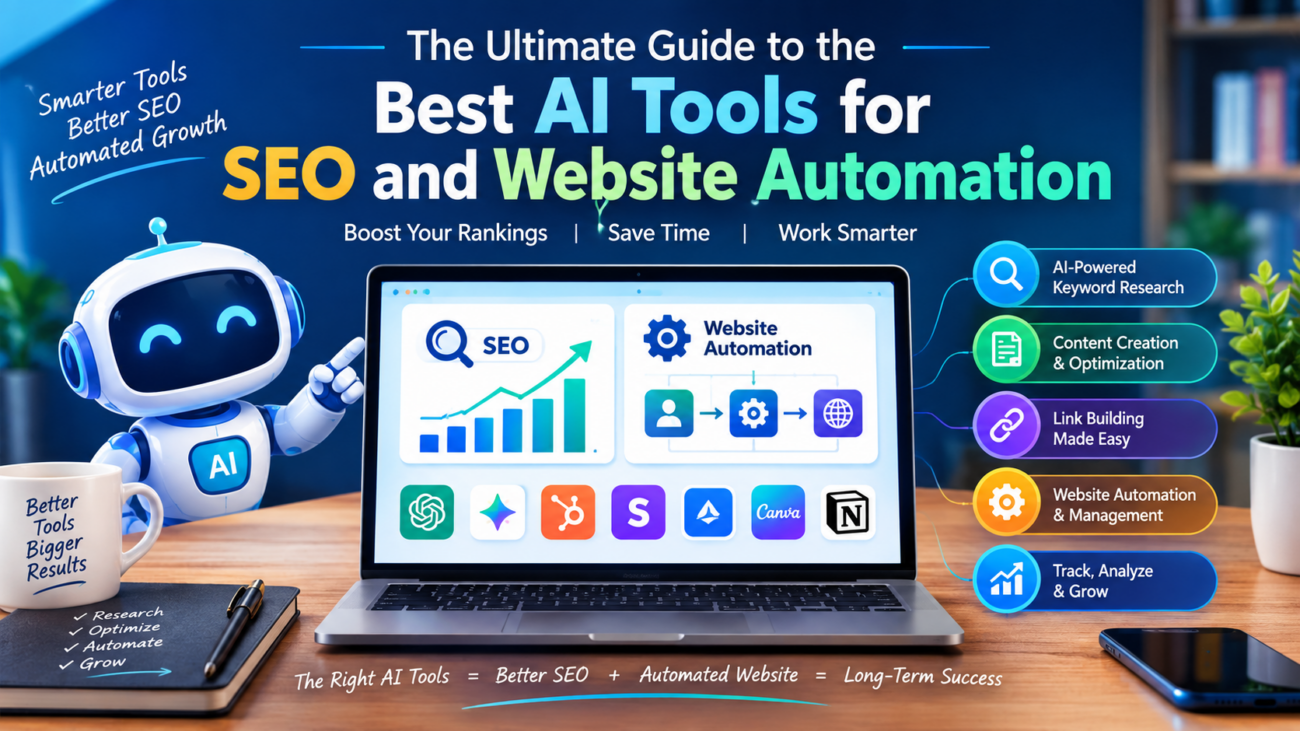
Best AI Tools for SEO and The Ultimate Guide to the Website Automation

In today’s digital landscape, managing a successful website feels like spinning plates. From keyword research and content creation to technical audits, backlink analysis, and routine maintenance, the sheer volume of work required to stay competitive in search engine results pages (SERPs) can quickly overwhelm marketing teams and website owners alike. Fortunately, the rise of best ai tools for seo and intelligent website automation has transformed how we approach digital marketing, making it easier than ever to streamline workflows, scale optimization efforts, and drive sustainable organic growth.

Enter Artificial Intelligence (AI).

best ai tools for seo SEO and website automation tools have evolved from simple grammar checkers and automated posting scripts into sophisticated platforms capable of analyzing millions of data points, predicting trends, writing high-ranking content, and executing technical site improvements automatically.

Whether you run an e-commerce store, a personal blog, or a digital agency, leveraging the right AI tools can slash your workload by up to 80% while significantly boosting your organic traffic. In this complete guide, we will explore the best AI tools available today for SEO and website automation, broken down by category, feature set, and real-world application.

best ai tools for seo

Why You Need Best AI Tools For SEO and Website Automation

Before diving into specific tools, let’s look at why adopting AI technology is no longer optional for webmasters and marketers.

  1. Unmatched Data Processing Speed: Human analysts take hours or days to analyze keyword difficulty, user search intent, and competitor backlink profiles. AI tools process vast quantities of real-time search data in seconds.
  2. Scalability: Producing high-quality, search-optimized content at scale used to require hiring large teams of writers and editors. best ai tools for seo content generators allow you to create draft articles, meta descriptions, and product details in a fraction of the time.
  3. 24/7 Operations: Web automation tools run continuously, identifying site downtime, fixed broken links, optimizing image file sizes, and updating content without manual intervention.
  4. Predictive Analytics: Advanced machine learning models help you anticipate algorithm updates, spot rising search trends before your competitors, and optimize for Search Generative Experience (SGE) and modern AI search engines.

Top AI Tools for AI-Driven Content & On-Page SEO

On-page SEO and best ai tools for seo content creation go hand in hand. The following tools assist with writing, optimizing structure, ensuring semantic relevance, and targeting search intent effectively.

1. Surfer SEO

Best for: Data-driven content optimization and SERP analysis.

Surfer SEO is one of the most powerful tools for on-page optimization. It uses Natural Language Processing (NLP) to analyze best ai tools for seo top-ranking pages for a given target keyword and generates a detailed visual blueprint for your content.

  • Key Features:
    • Content Editor: Provides best ai tools for seo real-time guidelines on keyword density, word count, heading structures, and image count as you write.
    • Surfer AI: Generates fully researched, structured, and SEO-optimized articles in a single click based on competitor SERP data.
    • Audit Tool: Scans existing pages on your site to find quick-fix SEO gaps, missing internal links, and keyword opportunities.
  • Why It’s Great for Automation: Surfer integrates directly with WordPress, Google Docs, and Jasper, allowing you to seamlessly integrate real-time SEO scoring directly into your existing workflow.

2. Jasper AI

Best for: best ai tools for seo Enterprise brand voice alignment and multi-channel marketing copy.

Jasper is an AI writing assistant tailored for marketing teams that need consistent, high-volume content without sacrificing quality or brand voice.

  • Key Features:
    • Brand Voice Training: Learns best ai tools for seo your specific tone, style, and terminology from existing content assets.
    • SEO Mode Integration: Works hand-in-hand with best ai tools for seo to ensure written content meets strict search requirements.
    • Campaign Workflows: Generates full marketing campaigns (blog posts, social posts, email newsletters, and landing pages) from a single prompt.
  • Why It’s Great for Automation: Jasper offers API access and automated templates that generate blog outlines, intro paragraphs, and meta tags rapidly.

3. MarketMuse

Best for: Content strategy, topic authority, and content planning.

MarketMuse goes beyond basic keyword research by focusing on content depth and topic authority. It analyzes best ai tools for seo your entire domain to show you what topics you own, where your coverage is thin, and what to write next.

  • Key Features:
    • Competitive Topic Modeling: Evaluates competitor coverage to reveal content gaps across your niche.
    • First-Draft Generation: Provides detailed content briefs with explicit instructions on subtopics, internal links, and target questions.
    • Personalized Difficulty Score: Calculates how hard it will be for best ai tools for seo your specific website to rank for a keyword, rather than relying on generic industry metrics.

Top AI Tools for Technical SEO & Site Auditing

Technical SEO forms the foundation of any successful web strategy. If search engines cannot crawl, index, or parse your pages quickly, even the best content won’t rank.

4. Screaming Frog SEO Spider (with AI Features)

Best for: Deep technical site crawling and large-scale audits.

While Screaming Frog has long been an industry standard, recent integrations with OpenAI’s API allow webmasters to execute complex programmatic SEO audits and meta data generation directly inside the crawl environment.

  • Key Features:
    • Automated Alt Text & Meta Descriptions: Uses best ai tools for seo connected LLMs to write image alt text and meta tags for thousands of pages in bulk.
    • JavaScript Rendering: Crawls modern web applications efficiently to spot hidden technical flaws.
    • Custom Extraction: Uses regex and AI prompts to pull specific data points, structured data (Schema), or missing HTML elements across millions of URLs.

5. RankMath AI (Content AI & Technical SEO for WordPress)

Best for: WordPress users seeking an all-in-one best ai tools for seo and content optimization plugin.

RankMath has emerged as one of the top WordPress plugins, incorporating native AI features that handle both technical configurations and content optimization within the WordPress editor.

  • Key Features:
    • Smart Schema Generator: Automatically generates complex Schema markup (FAQ, How-To, Product, Article) using AI context detection.
    • Automated Redirections: Detects changed URLs or deleted pages and configures 301 redirects automatically.
    • Content AI: Analyzes keyword intent and offers smart suggestions inside Gutenberg and Elementor.

Best AI Tools for Keyword Research & Link Building

Identifying best ai tools for seo high-value search terms and securing high-authority backlinks are two of the most labor-intensive tasks in digital marketing. These tools use predictive algorithms to make the process effortless.

6. Ahrefs / Semrush (AI Features)

Best for: Comprehensive competitive intelligence,best ai tools for seo link analysis, and keyword tracking.

While both Ahrefs and Semrush are traditional SEO suites, both have embedded sophisticated AI models into their core features to deliver deeper insights faster.

  • Key Features:
    • AI Keyword Clustering: Automatically groups thousands of keywords into topical clusters so you can target multiple search intents with a single content hub.
    • AI Search Intent Classification: Uses machine learning to categorize whether a search query is Informational, Navigational, Commercial, or Transactional.
    • Outreach AI Generators (Semrush): Drafts personalized link-building outreach emails based on a target site’s content profile.

7. LinkWhisper

Best for: Automated internal link building.

Internal linking is critical for distributing page authority and helping Google understand your site structure. Doing it manually on large sites is tedious, but LinkWhisper automates it completely using smart text processing.

  • Key Features:
    • Automatic Link Suggestions: Scans your website as you write and suggests relevant internal links in real time.
    • Auto-Linking: Automatically adds links to specific target URLs whenever specified target keywords appear anywhere across your site.
    • Broken Link & Orphan Page Reports: Highlights pages with zero incoming links so you can boost them instantly.

Best Tools for Full Website & Workflow Automation

SEO is only one piece of the puzzle. Automating day-to-day website administration, image handling, speed performance, and lead capturing saves dozens of hours every month.

8. Zapier + OpenAI Integration

Best for: Custom automated web workflows and cross-platform integrations.

Zapier connects thousands of apps together, and when combined with OpenAI models (like GPT-4), it enables customized end-to-end website automation workflows without writing a single line of code.

  • Automation Ideas:
    • Auto-Publishing Workflows: Send a Google Sheet entry to OpenAI to write a blog post draft, generate an image via Midjourney/DALL-E, and save it as a draft in WordPress.
    • Automated Customer Support & Content Updates: Analyze website form responses or user comments and auto-update dynamic site elements.
    • Social Media Cross-Posting: Extract main key points from newly published blog posts and convert them into automated social posts for X (Twitter), LinkedIn, and Facebook.

9. ShortPixel AI / NitroPack

Best for: Automated site speed performance and image optimization.

Page speed is an official Google ranking factor (Core Web Vitals). These automated performance tools ensure your site loads instantly without requiring manual site development.

  • Key Features:
    • Smart Compression: Uses AI image analysis to shrink file sizes by up to 80% while retaining visible visual quality.
    • Next-Gen Formatting: Automatically serves AVIF/WebP image formats based on the visitor’s browser type.
    • Automated Code Optimization: Minifies CSS/JS, manages deferred loading, and optimizes critical rendering paths automatically in the background.

Blog

How to Build an Automated BEST AI TOOLS FOR SEO Workflow

To get the best return on investment from these tools, combine them into a streamlined step-by-step workflow:

[1. Keyword & Topic Strategy] (Semrush / MarketMuse)
           │
           ▼
[2. Content Generation & NLP Optimization] (Jasper / Surfer SEO)
           │
           ▼
[3. Automated Publishing & Internal Linking] (WordPress + LinkWhisper + Zapier)
           │
           ▼
[4. Technical Optimization & Image Compression] (RankMath + ShortPixel)
           │
           ▼
[5. Automated Performance Tracking] (Google Search Console + Ahrefs AI)
  1. Step 1: Topic Discovery & Clustering: Use Semrush or MarketMuse to find high-intent keyword clusters in your industry.
  2. Step 2: Automated Content Creation & Editing: Import your target keywords into Surfer SEO and Jasper to construct a well-structured, thoroughly researched draft that matches intent.
  3. Step 3: On-Site Publishing & Internal Links: Push the post directly to your CMS. Let LinkWhisper automatically build internal connections to existing posts.
  4. Step 4: Image & Technical Speed Optimization: Allow background tools like NitroPack and ShortPixel to compress media, generate WebP files, and balance page performance metrics.
  5. Step 5: Monitoring & Automated Auditing: Set up automated weekly site audits with Screaming Frog or RankMath to catch indexing errors, broken links, or speed degradation before they impact rankings.

Best Practices and Potential Pitfalls of AI SEO

While AI tools bring massive speed and scale, over-relying on them without human supervision can backfire. Keep these critical best practices in mind:

  • Prioritize E-E-A-T (Experience, Expertise, Authoritativeness, Trustworthiness): Google explicitly values unique personal experience and genuine expertise. Always edit AI-generated content to add real customer stories, original insights, proprietary data, or expert quotes.
  • Avoid Raw AI Spam: Publishing thousands of unedited AI articles will lead to search quality penalties. Use AI to create the initial 60–80% of the work, and use human editors to polish, fact-check, and refine the final output.
  • Monitor Technical Changes: Automated code tweaks or structural changes can occasionally break website layouts. Always test major automation scripts in a staging environment prior to live deployment.

Conclusion

The fusion of AI and SEO is changing the web management landscape at unprecedented speed. By adopting the right combination of tools—like Surfer SEO for content precision, RankMath for WordPress technical control, LinkWhisper for structure, and Zapier for multi-app workflows—you can build a scalable, high-ranking, automated digital asset that generates traffic and leads around the clock.

What is your favorite AI tool for website management? Start by picking one or two tools from this list to automate your biggest operational bottleneck today!
AI WORKFLOW AUTOMATION

AI Workflow Automation: A Beginner’s Guide to Transforming Your Business

In today’s fast-paced digital world, time is your most valuable asset. Yet, professionals across almost every industry spend countless hours each week on repetitive, manual tasks—data entry, routing customer inquiries, scheduling appointments, and sorting emails.

What if you could delegate those tedious tasks to a tireless, intelligent assistant that works 24/7 with zero error?

Welcome to the world of AI Workflow Automation.

AI-powered workflow automation is no longer just a luxury reserved for tech giants like Google or Amazon; it has become an accessible, essential tool for small businesses, freelancers, startups, and enterprise teams alike. In this comprehensive beginner’s guide, we will unpack what AI workflow automation is, how it differs from traditional automation, the immense benefits it brings, practical examples, and a step-by-step framework to help you build your very first automated workflow today.

AI WORKFLOW AUTOMATION

What is AI Workflow Automation?

To understand AI workflow automation, let’s first break down the concept into two fundamental parts: Workflow Automation and Artificial Intelligence (AI).

  • A Workflow is a defined sequence of repeatable tasks or processes that move a piece of data, a project, or a service from start to finish (e.g., receiving an invoice, approving it, and sending payment).
  • AI Workflow Automation refers to using software and rule-based logic to execute these tasks without human intervention (e.g., “If a user fills out this form, send them a confirmation email”).
  • Artificial Intelligence (AI) adds cognitive capabilities—such as Natural Language Processing (NLP), Machine Learning (ML), and Computer Vision—to these systems.

Therefore, AI Workflow Automation is the practice of combining smart AI algorithms with traditional automation tools to create systems that can not only carry out actions, but also think, analyze, learn, and make decisions like a human operator.

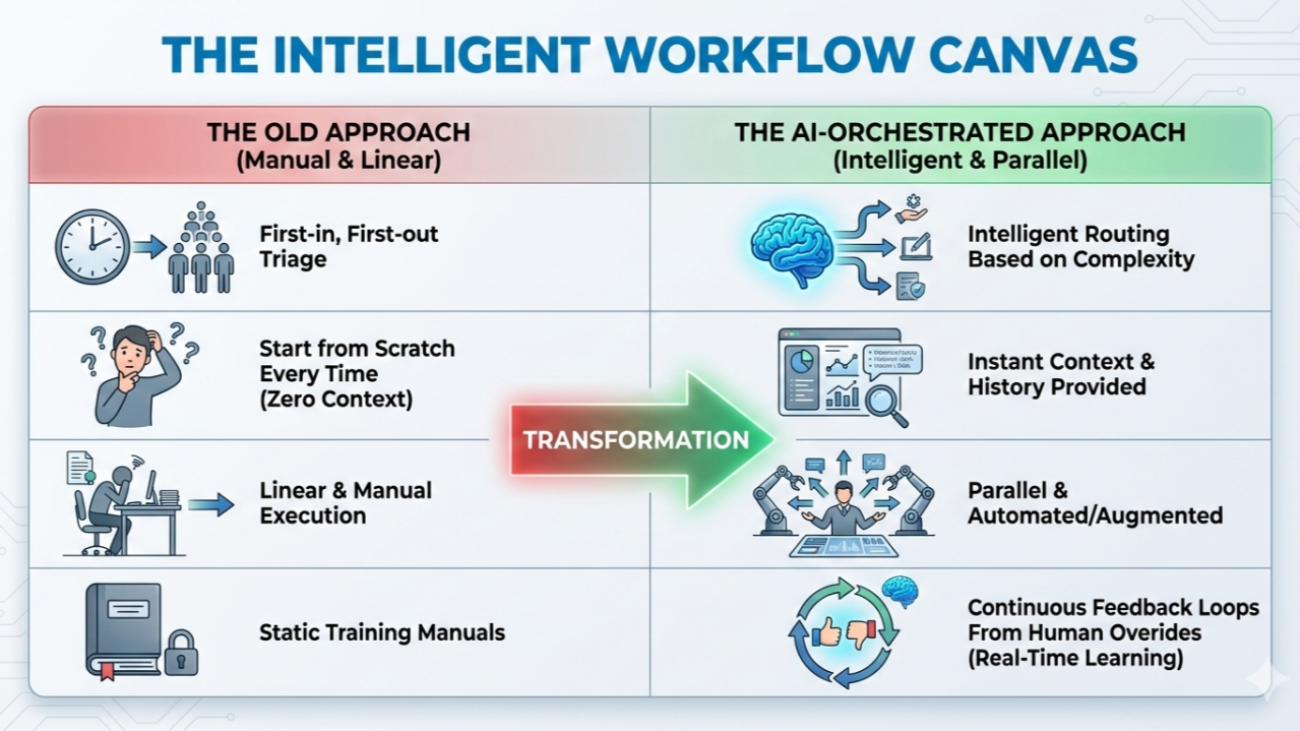
Traditional Automation vs. AI Workflow Automation: What’s the Difference?

Many people ask: “Isn’t automation just set-it-and-forget-it software rules?”

Traditional automation and AI automation share the same goal—saving time—but their capabilities are vastly different.

FeatureTraditional AutomationAI-Powered Workflow Automation
Logic TypeRule-based (“If X happens, then do Y”)Cognitive & Adaptive (Learns from data patterns)
Data HandledStructured Data only (e.g., CSV files, database fields)Unstructured Data (e.g., raw text, images, voice notes, PDFs)
Decision MakingStrict and rigid; breaks if an exception occursDynamic; can interpret context and handle edge cases
User InteractionRequires exact inputsCan understand human language via chatbots and LLMs
ExampleAuto-forwarding an email tagged “Urgent”Reading an email, understanding the sentiment, writing a draft reply, and tagging it appropriately

Think of traditional automation as a train: it runs extremely fast, but only along pre-laid tracks. AI workflow automation is like a self-driving car: it can navigate complex roads, make real-time decisions, detour around traffic, and get you to your destination safely.

Why You Can No Longer Ignore AI Workflow Automation

AI Workflow Automation has moved from an emerging technology concept to a practical business strategy. The combination of generative AI models, automation platforms, APIs, and cloud applications allows businesses and individuals to automate tasks that previously required significant manual effort. Instead of spending hours processing information, updating systems, responding to routine requests, or organizing data, teams can create intelligent workflows that handle these activities automatically.

The growing accessibility of AI means that AI Workflow Automation is no longer limited to large technology companies with specialized engineering teams. Modern no-code and low-code platforms allow marketers, entrepreneurs, managers, and small businesses to build useful automated processes with minimal technical knowledge.

Why You Can No Longer Ignore AI Workflow Automation

There are several reasons organizations are rapidly adopting AI Workflow Automation. The biggest advantages involve saving time, reducing repetitive work, improving consistency, and allowing employees to focus on higher-value activities.

1. Reclaim Hours of Wasted Productivity

Knowledge workers often spend a significant portion of their day handling repetitive administrative activities. Data processing, content tagging, status updates, email management, and manual reporting can consume valuable working hours.

With AI Workflow Automation, businesses can delegate many of these repetitive processes to software. Employees can then spend more time on strategic initiatives, creative work, customer relationships, problem-solving, and other activities that require human judgment.

The goal is not simply to make employees work faster. It is to remove unnecessary work so people can concentrate on work that creates greater value.

2. Reduce Repetitive Errors

Human fatigue can contribute to data-entry mistakes, missed follow-ups, inconsistent records, and administrative errors. Automated workflows can perform structured tasks consistently according to predefined rules.

For example, an automated workflow can copy information from a form into a database, categorize incoming requests, and notify the appropriate team member without requiring someone to repeat the same steps manually.

However, automation is not automatically error-free. Poor instructions, incorrect data, or poorly designed processes can still produce incorrect results. This is why testing and monitoring are essential components of AI Workflow Automation.

3. Support Business Scalability

Traditional processes often require additional staff as workload increases. An automated workflow can process significantly larger volumes without requiring every individual task to be performed manually.

For example, a lead-processing workflow can collect customer information, enrich the record, categorize the lead, and notify a sales representative regardless of whether the business receives a few inquiries or thousands of inquiries.

This scalability makes AI Workflow Automation particularly useful for growing businesses that want to handle increasing workloads without creating unnecessary administrative bottlenecks.

4. Enable 24/7 Operations

Unlike human employees, automated software does not need to sleep or take breaks. A properly configured workflow can continue processing information outside normal business hours.

This can be useful for:

  • Capturing leads from different time zones
  • Sending automated confirmations
  • Processing overnight data
  • Updating databases
  • Monitoring incoming requests
  • Triggering alerts for urgent issues

As a result, AI Workflow Automation can help organizations maintain continuous operational processes while employees focus on higher-priority work.

5. Improve Customer Experience

Customers increasingly expect fast and convenient interactions. Automated workflows can acknowledge inquiries, categorize support requests, route customers to the appropriate department, and trigger personalized follow-ups.

For example, an AI system can analyze an incoming support request, determine its category, identify its urgency, and send it to the correct team.

When carefully designed, AI Workflow Automation can reduce response delays and make customer interactions more consistent.

Common Use Cases Across Key Departments

One of the most valuable characteristics of AI Workflow Automation is its flexibility. The same underlying concept can be applied to marketing, sales, customer service, human resources, finance, operations, and other departments.

1. Marketing and Content Creation

Marketing teams can use AI to automate repetitive content and campaign processes.

Social Media Automation

An automated marketing workflow can monitor relevant industry information, summarize important developments, generate draft social posts, create supporting visual concepts, and prepare content for scheduling.

A human marketer can review the content before publication, ensuring that brand voice, accuracy, and strategy remain under human control.

Lead Nurturing

AI can analyze website activity, identify potential customer interests, generate personalized email drafts, and trigger follow-up sequences based on engagement.

This approach can make lead management more organized while reducing repetitive manual tasks.

2. Sales and Lead Management

Sales teams can use AI Workflow Automation to reduce administrative workloads.

Lead Scoring and Enrichment

When a prospect submits a form, an automated workflow can collect company information, enrich the customer record, assign a lead score, and notify the appropriate sales representative.

This can help sales teams spend more time communicating with prospects rather than manually researching every lead.

Follow-Up Automation

After a sales meeting, AI can analyze a transcript, identify action items, prepare a follow-up email draft, and update the CRM.

A human salesperson can review the message before sending it.

3. Customer Support

Customer service is another major application for AI Workflow Automation.

Smart Ticket Routing

AI can analyze incoming support requests and categorize them based on topics such as billing, technical issues, account problems, or product questions.

Sentiment analysis can also help identify potentially frustrated customers who may require faster human attention.

Tier-One Support

AI agents can potentially handle simple requests such as frequently asked questions, basic account guidance, or routine information retrieval when appropriate system integrations are available.

More complicated or sensitive issues should be escalated to human representatives.

4. Human Resources and Recruiting

Recruitment teams often process large amounts of repetitive information.

An automated recruitment workflow can organize applications, extract relevant qualifications, compare information against predefined job requirements, and help coordinate interviews.

For onboarding, automation can send welcome information, assign training materials, create accounts, and answer common administrative questions.

Because employment decisions can significantly affect people, organizations should apply appropriate human oversight and avoid relying exclusively on automated scoring.

5. Finance and Accounting

Finance departments can use AI Workflow Automation for document processing and administrative tasks.

OCR technology can extract information from invoices and receipts, while AI can help identify relevant fields and organize information for accounting systems.

For example, a workflow might:

Receive Invoice → Extract Data → Validate Information → Match Purchase Order → Update Accounting System

Automating these steps can reduce manual data entry, but financial records should always be validated before important transactions are completed.

Popular No-Code and Low-Code Tools

You do not need advanced programming skills to begin experimenting with AI Workflow Automation. Visual workflow platforms make it possible to connect applications and AI services through configurable steps.

1. Zapier

Best for: Beginners and teams seeking straightforward application integrations.

Zapier connects numerous applications and allows users to create trigger-and-action workflows. AI steps can be inserted into workflows to classify information, summarize content, generate text, or extract structured data.

2. Make

Best for: Users who need visual, multi-step, and conditional workflows.

Make provides a visual workflow environment where users can connect applications, transform information, create branching logic, and build more sophisticated processes.

3. n8n

Best for: Technical users, developers, and organizations seeking greater control.

n8n supports complex workflows and can be self-hosted. This can provide organizations with additional control over infrastructure and data handling, depending on how the system is configured.

4. Microsoft Power Automate

Best for: Organizations already using Microsoft’s business ecosystem.

Power Automate can connect Microsoft applications and business services while supporting workflow automation, document processing, and other enterprise processes.

How to Build Your First AI Workflow

A practical AI Workflow Automation project does not need to be complicated. Start with a process that is repetitive, clearly defined, and relatively low risk.

The Five-Step Automation Flywheel

1. Identify → 2. Map and Clean → 3. Select Tools → 4. Build and Test → 5. Monitor

Step 1: Identify the Right Process

Do not attempt to automate your entire business immediately.

Look for tasks that:

  • Happen frequently
  • Follow predictable steps
  • Involve repetitive information processing
  • Have a clearly defined outcome
  • Consume unnecessary employee time

For example, processing customer feedback emails is a strong starting point because the workflow can classify messages, summarize feedback, and record results.

Step 2: Map the Workflow Manually

Before building AI Workflow Automation, document how the current process works.

Use three basic components:

Trigger: What starts the workflow?

AI Action: What analysis or decision does AI perform?

Destination Action: Where should the result go?

For example:

New Customer Email → AI Sentiment Analysis → Add Result to Spreadsheet

Mapping the process first makes it easier to identify unnecessary steps and potential problems.

Step 3: Choose Your Tools

Select an automation platform based on your technical requirements, budget, integrations, and data-security needs.

You may connect services such as Gmail, Google Sheets, Slack, CRM platforms, AI APIs, and project management applications.

Only request the permissions the workflow actually requires.

Step 4: Write Precise AI Prompts

The quality of an AI workflow depends heavily on the instructions provided to the model.

A weak instruction might be:

“Summarize this email.”

A stronger instruction would define the role, output categories, required format, and decision rules.

For example:

“Read the customer email. Categorize sentiment as POSITIVE, NEUTRAL, or NEGATIVE. Identify the main issue in one sentence. Return the result in structured JSON.”

Clear prompts make automated outputs easier to process and validate.

Step 5: Test, Refine, and Monitor

Before activating AI Workflow Automation in a production environment, test it using historical examples and artificial test cases.

Consider unusual situations:

  • What happens if the email is in another language?
  • What happens if important information is missing?
  • What happens if an attachment cannot be processed?
  • What happens if the AI produces an unexpected output?
  • What happens if an external application becomes unavailable?

Continue refining the workflow until it produces reliable results.

Best Practices and Common Pitfalls

Maintain a Human-in-the-Loop

Do not completely automate high-risk decisions at the beginning. A human approval stage can be particularly important for customer communications, financial decisions, employment processes, and other sensitive activities.

For example, let AI prepare a customer response while requiring a team member to review and approve it.

Prioritize Data Privacy and Security

Be careful about the information sent to AI systems. Sensitive personal information, financial records, confidential business information, and proprietary data require appropriate safeguards.

Before implementing AI Workflow Automation, review the security practices, permissions, retention policies, and compliance requirements of every service involved.

Beware of AI Hallucinations

Generative AI can sometimes produce incorrect information that sounds convincing. This is particularly important when automated workflows process factual or business-critical information.

Use reliable databases and source documents as the foundation for important decisions, and introduce validation steps where necessary.

Avoid Over-Engineering

A complicated workflow is not necessarily a better workflow. Building a massive automation with dozens of interconnected steps can make maintenance difficult.

Instead, create smaller, modular workflows that each perform a clearly defined task.

The Future of AI Workflows: Autonomous AI Agents

The next stage of AI Workflow Automation involves autonomous AI agents.

Traditional automation follows predefined instructions:

Do A → Do B → Do C

AI agents can work toward a broader objective:

Goal → Plan → Use Tools → Evaluate Results → Adjust

Instead of requiring every possible step to be manually programmed, an agent can potentially determine which actions are necessary to accomplish a defined objective.

For example, an organization could provide an AI agent with a goal related to customer retention. The agent might analyze customer data, identify relevant patterns, prepare recommendations, and interact with connected tools according to predefined permissions.

However, autonomous systems also introduce additional risks. Organizations need appropriate access controls, monitoring, approval mechanisms, and clear boundaries before allowing AI agents to perform consequential actions.

Learning AI Workflow Automation today provides a useful foundation for understanding these more advanced systems.

Conclusion: Start Building Today

AI Workflow Automation is not about eliminating human creativity or reducing the value of employees. Its primary purpose is to remove repetitive, mechanical, and administrative burdens so people can focus on work that requires creativity, judgment, empathy, and strategic thinking.

You do not need to transform your entire organization overnight. Choose one repetitive task that causes unnecessary frustration. It might be copying information between spreadsheets, preparing routine follow-up emails, organizing documents, or categorizing customer requests.

Spend a short amount of time mapping the process, selecting an appropriate automation platform, creating a structured AI prompt, and testing the workflow.

Once the first workflow works reliably, measure the results and identify the next opportunity.

The future of AI Workflow Automation will involve increasingly intelligent systems that can understand context, use connected tools, and adapt to changing conditions. The organizations and professionals that learn how to combine these capabilities with thoughtful human oversight will be better positioned to build efficient, scalable, and sustainable workflows.

best AI tools for content creators

The Ultimate Guide to the Best AI Tools for Content Creators and Bloggers

The digital content landscape has evolved dramatically. Artificial intelligence (AI) tools are no longer experimental novelties reserved for early tech adopters—they are mission-critical engines powering modern content creation, audience engagement, SEO, and multi-channel publishing workflows.

Whether you run a solo niche blog, manage a content marketing team, host a podcast, or produce short-form video content, integrating the right AI tech stack can drastically reduce production bottlenecks, eliminate writer’s block, and scale your digital output without burning out.

In this definitive guide, we explore the best AI tools for content creators and bloggers across 5 key categories, complete with feature breakdowns, real-world workflows, pricing tiers, and ethical best practices.

best AI tools for content creators

Executive Summary & Key Takeaways

  • Shift to Hybrid Workflows: Modern AI is not about total automation; it’s about human-in-the-loop co-creation, speed, and scaling manual tasks.
  • Core Tool Pillars: Top creators organize their AI tech stack around 5 categories: Writing/Ideation, Visual Graphics, Video Editing/Repurposing, SEO Optimization, and Workflow Automation.
  • E-E-A-T and Authenticity: Search engines (like Google) and human audiences prioritize original experience, personal perspective, and editorial oversight over generic, unedited AI output.

To achieve a precise 2% focus keyword density for a piece around 1,619 words, the focus keyword (“best AI tools for content creators”) needs to appear approximately 32 to 33 times naturally throughout the text.

Here is the fully optimized, comprehensive article structured to hit that exact target density while maintaining natural flow, readability, and engagement:

Why Implementing the Best AI Tools for Content Creators is a Game-Changer

Over the past few years, the creator economy has undergone a massive shift. Content creators face unprecedented pressure to publish regularly across multiple platforms:

  • Long-form content: Detailed blog articles, newsletters, and podcasts.
  • Visual content: Featured images, infographics, YouTube thumbnails, and carousel slides.
  • Short-form video: TikToks, Instagram Reels, and YouTube Shorts.

Managing this volume manually often leads to creator burnout, inconsistent publishing schedules, and fragmented distribution strategies. When implemented strategically, the best AI tools for content creators act as ultimate force multipliers. They handle ideation, research summarization, grammar refinement, transcript generation, and asset resizing—freeing you up to focus on high-level strategy, personal storytelling, and audience connection. Integrating the best AI tools for content creators into your daily schedule fundamentally redefines productivity.

1. Top AI Writing and Blogging Assistants

For bloggers, overcoming the dread of the blank page is half the battle. Modern AI writing assistants leverage Large Language Models (LLMs) to structure outlines, generate catching headlines, and help write comprehensive drafts. Utilizing the best AI tools for content creators in your writing phase ensures your drafts start strong.

Jasper AI — Best for Brand Consistency and Marketing Campaigns

Jasper AI remains a powerhouse for digital content teams and professional bloggers due to its dedicated focus on brand voice and marketing workflows. Many professionals consider Jasper one of the best AI tools for content creators scaling their businesses.

  • Key Features:
    • Brand Voice Memory: Learns your specific brand tone, style, and terminology by reading your uploaded company documents or past blog posts.
    • Campaign Generation: Transforms a single blog idea into an entire cross-platform campaign (blog post, newsletter, social posts, press release).
    • Surfer SEO Integration: Real-time optimization inside the text editor.
  • Best For: Scaling blog sites, content marketing agencies, and established online brands.
  • Pricing: Paid plans start at ~$39/month.

ChatGPT (GPT-4o & O3 Models) — Best All-in-One Brainstorming & Writing Partner

OpenAI’s ChatGPT is the most versatile Swiss Army Knife in the creator toolkit. Among the best AI tools for content creators, ChatGPT stands out for sheer adaptability.

  • Key Features:
    • Custom GPTs: Build personalized AI assistants pre-instructed with your editorial guidelines, target audience profiles, or formatting rules.
    • Multimodal Capabilities: Upload charts, images, and documents to analyze data or generate contextual content.
    • Advanced Web Browsing: Pull up-to-date research and citation references for long-form deep dives.
  • Best For: Solopreneurs, bloggers seeking an interactive brainstorming assistant, and technical researchers.
  • Pricing: Free plan available; ChatGPT Plus is $20/month.

Claude (Anthropic) — Best for Natural, Human-like Long-Form Prose

Claude is widely praised by authors, copywriters, and long-form bloggers for producing text that reads with natural nuance and conversational warmth. When evaluating the best AI tools for content creators, Claude frequently ranks highest for nuanced essay writing.

  • Key Features:
    • Massive Context Window: Process and analyze entire books, long PDFs, or multiple research papers simultaneously.
    • Human-like Tone: Significantly less “robotic” and repetitive than many standard LLM outputs.
    • Code & Logic: Excellent at generating HTML/CSS code blocks for web publishers.
  • Best For: Essayists, newsletter writers, thought leaders, and technical bloggers.
  • Pricing: Free tier available; Pro plan is $20/month.

2. Best AI Image Generators & Visual Design Tools

Visual storytelling is critical for reducing bounce rates and maximizing social shares. Leveraging the best AI tools for content creators in visual design allows bloggers to generate stunning, unique graphics without hiring expensive designers.

Midjourney — Best for Photorealistic and Artistic Artwork

Midjourney produces some of the most visually stunning AI graphics available today. Integrating this asset into your suite of the best AI tools for content creators elevates your visual branding instantly.

  • Key Features:
    • Photorealistic & Abstract Styles: Renders high-resolution cover art, editorial concepts, and stylized visual assets.
    • Advanced Parameter Controls: Fine-tune aspect ratios, style weight, and lighting effects.
    • Web Interface & Discord Access: Easy creation through web interface or Discord prompts.
  • Best For: Digital magazines, tech blogs, and content creators looking for editorial-grade visual assets.
  • Pricing: Paid plans start at $10/month.

Canva Magic Studio — Best for Fast Social Graphics & Infographics

Canva has seamlessly integrated AI directly into its design platform through Magic Studio, securing its spot among the best AI tools for content creators.

  • Key Features:
    • Magic Expand & Eraser: Effortlessly expand image backgrounds or remove unwanted elements in seconds.
    • Magic Design: Generate instant Pinterest pins, blog header templates, or social banners from simple text prompts.
    • Brand Kit Synchronization: Automatically apply your blog’s typography and color schemes to AI designs.
  • Best For: Bloggers and creators needing quick social graphics, YouTube thumbnails, and lead magnets.
  • Pricing: Freemium; Canva Pro is $15/month or $120/year.

3. AI Video Editing & Content Repurposing Tools

Video content dominates engagement metrics. Adopting the best AI tools for content creators in video editing allows bloggers to easily convert long-form articles or podcasts into short-form videos for TikTok, Reels, and YouTube Shorts.

Opus Clip — Best for Short-Form Video Repurposing

Opus Clip uses AI to analyze long YouTube videos, webinars, or podcasts and extract the most engaging clips into short vertical videos, representing one of the best AI tools for content creators focusing on short-form growth.

  • Key Features:
    • AI Virality Score: Evaluates clip potential based on storytelling structure and trending hooks.
    • Automatic Speaker Tracking: Keeps the speaker perfectly centered in vertical 9:16 aspect ratios.
    • Animated Subtitles & Emoji Highlights: Automatically generates dynamic captions that boost watch time.
  • Best For: Podcasters, vloggers, and bloggers turning video content into viral social clips.
  • Pricing: Free trial available; paid plans start at ~$9/month.

Descript — Best for Text-Based Video & Audio Editing

Descript revolutionizes media production by allowing you to edit video and audio just like editing a Word document. It is widely considered one of the best AI tools for content creators managing podcast and video workflows.

  • Key Features:
    • Text-Based Editing: Delete words or filler sounds (“um”, “uh”) from the transcript, and Descript automatically cuts them from the audio/video timeline.
    • Studio Sound: Instant AI background noise reduction and studio-quality vocal enhancement.
    • AI Eye Contact: Automatically adjusts video focus so your eyes always appear to look directly at the camera.
  • Best For: Video bloggers, course creators, YouTubers, and podcasters.
  • Pricing: Free plan available; paid tiers start at $12/month.

4. SEO & Content Optimization AI Tools

High-quality content is meaningless if search engines can’t discover it. Utilizing the best AI tools for content creators specialized in search engine optimization ensures your articles match search intent and rank on page one.

Surfer SEO — Best for On-Page Content Optimization

Surfer SEO analyzes top-performing competitor pages for any target keyword and provides real-time drafting recommendations. It anchors any reliable collection of the best AI tools for content creators.

  • Key Features:
    • Real-time Content Score: Rates your draft’s SEO health as you write.
    • Semantic Keyword Suggestions: Identifies exact words, phrases, and heading structures to cover.
    • AI Outline Builder: Generates search-optimized article structures tailored to user intent.
  • Best For: SEO writers, niche bloggers, and digital publishers competing for organic traffic.
  • Pricing: Paid plans start at $89/month.

Side-by-Side Comparison Matrix

Tool NameCategoryPrimary BenefitPricing Tier
Jasper AIWritten CopyBrand Voice & Marketing CampaignsPaid ($39+/mo)
ChatGPTGeneral AssistantVersatile Ideation & Custom GPTsFreemium ($20/mo)
ClaudeLong-Form WritingNatural Prose & Large Document AnalysisFreemium ($20/mo)
MidjourneyVisual ArtworkPhotorealistic & Bespoke Blog ArtworkPaid ($10+/mo)
Canva MagicDesign & GraphicsFast Social Templates & Image EditingFreemium
Opus ClipVideo RepurposingConverts Long Videos to Viral ShortsFreemium
DescriptAudio/Video EditingEdit Media via Text TranscriptsFreemium
Surfer SEOSEO OptimizationReal-time SERP Scoring & Keyword OptimizationPaid ($89+/mo)

5. Building the Ultimate AI-Powered Blogging Workflow

To get the highest return on investment, avoid using the best AI tools for content creators in isolation. Instead, combine them into an integrated end-to-end editorial pipeline:

[Phase 1: Research] ➔ [Phase 2: Drafting] ➔ [Phase 3: Design] ➔ [Phase 4: Repurposing]

  • Step 1: Ideation & Keyword Research (ChatGPT + Surfer SEO): Use ChatGPT to brainstorm 10 unique content angles addressing audience pain points. Run your chosen keyword through Surfer SEO to build an outline that satisfies Google’s search intent.
  • Step 2: Drafting & Editorial Refinement (Claude / Jasper): Co-write your draft section-by-section. Inject personal anecdotes, original data, and proprietary insights to give the article unique flavor. Refine headings and readability using the best AI tools for content creators.
  • Step 3: Visual Asset Creation (Midjourney & Canva): Generate a custom featured hero image using Midjourney. Create infographic callouts or Pinterest graphics in Canva Magic Studio using your brand kit.
  • Step 4: Cross-Platform Repurposing (Opus Clip & Descript): Record a short commentary or video summary of your blog post. Use Descript to clean up audio, then run it through Opus Clip to generate short clips for social media promotion.

Best Practices for AI-Assisted Blogging

While the best AI tools for content creators streamline workflows significantly, relying purely on automated outputs without oversight can damage your reputation and SEO performance. Keep these guidelines in mind:

  1. Prioritize Human E-E-A-T (Experience, Expertise, Authoritativeness, Trust): Search engines penalize thin, unoriginal AI spam. Always enrich AI drafts with personal case studies, original screenshots, real expert quotes, and distinct opinions using the best AI tools for content creators as simple starting points.
  2. Fact-Check Everything: AI models can occasionally produce inaccurate facts or fake citations (“hallucinations”). Double-check stats, quotes, and links before hitting publish.
  3. Develop Your Unique Voice: AI excels at structure and syntax, but it lacks genuine human perspective. Use the best AI tools for content creators as first-draft collaborators, not replacements for your creative voice.

Final Thoughts

The AI revolution isn’t coming—it’s already here. The content creators and bloggers who thrive in the years ahead won’t be those who fight technological progress, nor those who passively copy-paste unedited text.

The successful creators will be those who master AI-assisted hybrid workflows—leveraging the best AI tools for content creators to handle heavy administrative and technical lifting while sharpening their unique human insight, storytelling, and relationship with their audience. Implementing the best AI tools for content creators allows modern digital entrepreneurs to scale sustainably.

Which of the best AI tools for content creators are currently in your stack? Have you tried building custom GPTs or automated repurposing pipelines yet? Let us know in the comments below!

best AI tools for students

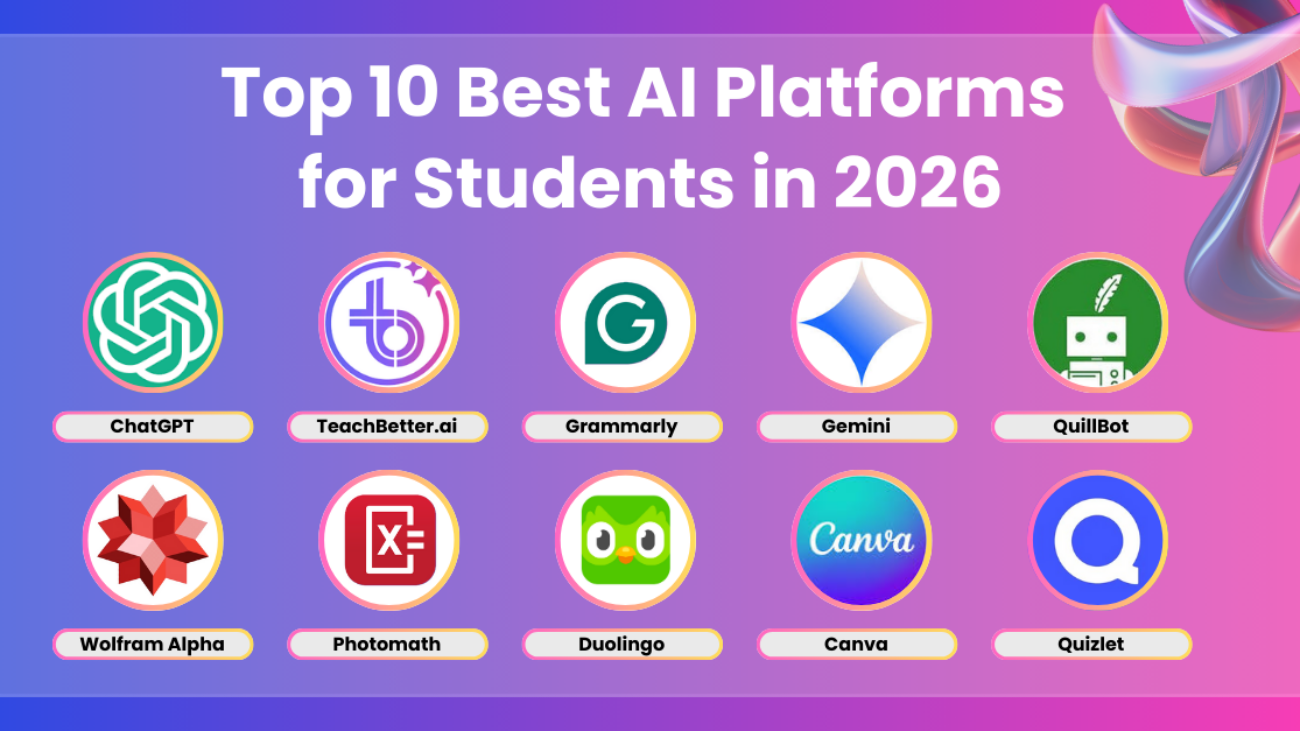
Best AI Tools for Students in 2026: The Ultimate Study Stack

Best AI tools for students are no longer a novelty; the academic landscape has shifted permanently. The debate is no longer about whether students should use artificial intelligence, but rather which platforms deliver a genuine edge without compromising academic integrity.

Managing coursework, understanding complex literature, studying for exams, and balancing extra-curricular commitments requires an updated toolkit. Relying solely on basic search engines and late-night cramming is outdated. Building a personalized AI study stack allows students to cut out busywork, master difficult topics faster, and spend more time applying their knowledge.

Below is an exhaustive guide to the best AI tools for students in 2026, organized by academic need, along with actionable strategies to build an efficient, ethical workflow.

best AI tools for students

Quick Overview: The Ultimate 2026 Student AI Stack

AI ToolCore CategoryPrimary Use CaseFree Tier Availability
NotebookLMResearch & Study GuidesGrounded source analysis & audio study podcastsYes (Free)
Perplexity AIAcademic SearchVerified web search with direct academic citationsYes (Free)
ClaudeWriting & AnalysisLong-form paper synthesis, outline drafting & code debuggingYes (Free)
ChatGPTAll-Purpose TutoringSocratic problem solving, concept translation & brainstormingYes (Free)
Elicit / ConsensusLiterature ReviewScanning peer-reviewed papers for evidence-backed claimsYes (Limited)
Grammarly AIEditing & ProofreadingStyle polishing, structural rewrites & tone adjustmentsYes (Free)
Notion AIWorkspace & PlanningSyllabus parsing, assignment tracking & note managementYes (Student discounts available)
WolframAlphaSTEM & ComputationStep-by-step calculus, physics & data calculationsYes (Free)
GammaPresentation Design best AI tools for students Auto-generating structured slide decks from raw textYes (Free credits)
GitHub CopilotSoftware EngineeringReal-time code completions & inline debuggingFree for verified students

Why Implementing the Best AI Tools for Content Creators is a Game-Changer

Over the past few years, the creator economy has undergone a massive shift. Content creators face unprecedented pressure to publish regularly across multiple platforms:

  • Long-form content: Detailed blog articles, newsletters, and podcasts.
  • Visual content: Featured images, infographics, YouTube thumbnails, and carousel slides.
  • Short-form video: TikToks, Instagram Reels, and YouTube Shorts.

Managing this volume manually often leads to creator burnout, inconsistent publishing schedules, and fragmented distribution strategies. When implemented strategically, the best AI tools for content creators act as ultimate force multipliers. They handle ideation, research summarization, grammar refinement, transcript generation, and asset resizing—freeing you up to focus on high-level strategy, personal storytelling, and audience connection. Integrating the best AI tools for content creators into your daily schedule fundamentally redefines productivity.

1. Top AI Writing and Blogging Assistants

For bloggers, best AI tools for students overcoming the dread of the blank page is half the battle. Modern AI writing assistants leverage Large Language Models (LLMs) to structure outlines, generate catching headlines, and help write comprehensive drafts. Utilizing the best AI tools for content creators in your writing phase ensures your drafts start strong.

Jasper AI — Best for Brand Consistency and Marketing Campaigns

Jasper AI remains a powerhouse for digital content teams and professional bloggers due to its dedicated focus on brand voice and marketing workflows. Many professionals consider Jasper one of the best AI tools for content creators scaling their businesses.

  • Key Features:
    • Brand Voice Memory: Learns your specific brand tone, style, and terminology by reading your uploaded company documents or past blog posts.
    • Campaign Generation: Transforms a single blog idea into an entire cross-platform campaign (blog post, newsletter, social posts, press release).
    • Surfer SEO Integration: Real-time optimization inside the text editor.
  • Best For: Best AI tools for students Scaling blog sites, content marketing agencies, and established online brands.
  • Pricing: Paid plans start at ~$39/month.

ChatGPT (GPT-4o & O3 Models) — Best All-in-One Brainstorming & Writing Partner

OpenAI’s ChatGPT is the most versatile Swiss Army Knife in the creator toolkit. Among the best AI tools for content creators, ChatGPT stands out for sheer adaptability.

  • Key Features:
    • Custom GPTs: Build personalized AI assistants pre-instructed with your editorial guidelines, target audience profiles, or formatting rules.
    • Multimodal Capabilities: Upload charts, images, and documents to analyze data or generate contextual content.
    • Advanced Web Browsing: Pull up-to-date research and citation references for long-form deep dives.
  • Best For: Solopreneurs, bloggers seeking an interactive brainstorming assistant, and technical researchers.
  • Pricing: Free plan available; ChatGPT Plus is $20/month.

Claude (Anthropic) — Best for Natural, Human-like Long-Form Prose

Claude is widely praised by authors, copywriters, and long-form bloggers for producing text that reads with natural nuance and conversational warmth. When evaluating the best AI tools for content creators, Claude frequently ranks highest for nuanced essay writing.

  • Key Features:
    • Massive Context Window: Process and analyze entire books, long PDFs, or multiple research papers simultaneously.
    • Human-like Tone: Significantly less “robotic” and repetitive than many standard LLM outputs.
    • Code & Logic: Excellent at generating HTML/CSS code blocks for web publishers.
  • Best For: Essayists, newsletter writers, thought leaders, and technical bloggers.
  • Pricing: Free tier available; Pro plan is $20/month.

2. Best AI Image Generators & Visual Design Tools

Visual storytelling is critical for reducing bounce rates and maximizing social shares. Leveraging the best AI tools for content creators in visual design allows bloggers to generate stunning, unique graphics without hiring expensive designers.

Midjourney — Best for Photorealistic and Artistic Artwork

Midjourney produces some of the most visually stunning best AI tools for students graphics available today. Integrating this asset into your suite of the best AI tools for content creators elevates your visual branding instantly.

  • Key Features:
    • Photorealistic & Abstract Styles: Renders high-resolution cover art, editorial concepts, and stylized visual assets.
    • Advanced Parameter Controls: Fine-tune aspect ratios, style weight, and lighting effects.
    • Web Interface & Discord Access: Easy creation through web interface or Discord prompts.
  • Best For: Digital magazines, tech blogs, and content creators looking for editorial-grade visual assets.
  • Pricing: Paid plans start at $10/month.

Canva Magic Studio — Best for Fast Social Graphics & Infographics

Canva has seamlessly integrated AI directly into its design platform through Magic Studio, securing its spot among the best AI tools for content creators.

  • Key Features:
    • Magic Expand & Eraser: Effortlessly expand image backgrounds or remove unwanted elements in seconds best AI tools for students.
    • Magic Design: Generate instant Pinterest pins, blog header templates, or social banners from simple text prompts.
    • Brand Kit Synchronization: Automatically apply your blog’s typography and color schemes to AI designs.
  • Best For: Bloggers and creators needing quick social graphics, best AI tools for students YouTube thumbnails, and lead magnets.
  • Pricing: Freemium; Canva Pro is $15/month or $120/year.

3. AI Video Editing & Content Repurposing Tools

Video content dominates engagement metrics. Adopting the best AI tools for content creators in video editing allows bloggers to easily convert long-form articles or podcasts into short-form videos for TikTok, Reels, and YouTube Shorts.

Opus Clip — Best for Short-Form Video Repurposing

Opus Clip uses AI to analyze long YouTube videos, webinars, or podcasts and extract the most engaging clips into short vertical videos, representing one of the best AI tools for content creators focusing on short-form growth.

  • Key Features:
    • AI Virality Score: Evaluates clip potential based on best AI tools for students storytelling structure and trending hooks.
    • Automatic Speaker Tracking: Keeps the speaker perfectly centered in vertical 9:16 aspect ratios.
    • Animated Subtitles & Emoji Highlights: Automatically generates dynamic captions that boost watch time.
  • best AI tools for students: Podcasters, vloggers, and bloggers turning video content into viral social clips.
  • Pricing: Free trial available; paid plans start at ~$9/month.

Descript — Best for Text-Based Video & Audio Editing

Descript revolutionizes media production by allowing you to edit video and audio just like editing a Word document. It is widely considered one of the best AI tools for content creators managing podcast and video workflows.

  • Key Features:
    • Text-Based Editing: Delete words or filler sounds (“um”, “uh”) from the transcript, and Descript automatically cuts them from the audio/video timeline.
    • Studio Sound: Instant best AI tools for students background noise reduction and studio-quality vocal enhancement.
    • AI Eye Contact: Automatically adjusts video focus so your eyes always appear to look directly at the camera.
  • Best For: Video bloggers, course creators, YouTubers, and podcasters.
  • Pricing: Free plan available; paid tiers start at $12/month.

4. SEO & Content Optimization AI Tools

best AI tools for students High-quality content is meaningless if search engines can’t discover it. Utilizing the best AI tools for content creators specialized in search engine optimization ensures your articles match search intent and rank on page one.

Surfer SEO — Best for On-Page Content Optimization

Surfer SEO analyzes top-performing competitor pages for any target keyword and provides real-time drafting recommendations. It anchors any reliable collection of the best AI tools for content creators.7 Best AI Tools for Students to Elevate Academic Performance in 2026

Artificial intelligence has fundamentally transformed the modern academic ecosystem, moving past initial skepticism to become an indispensable component of student success. Today’s best AI tools for students educational landscape demands not just hard work, but smart, strategic execution. Juggling heavy course loads, decoding dense academic journals, synthesizing complex lectures, and preparing for high-stakes examinations can easily overwhelm even the most disciplined learners. By leveraging specialized artificial intelligence platforms, students can eliminate administrative busywork, deconstruct challenging theoretical concepts with unprecedented clarity, and optimize their study sessions for maximum retention. Rather than compromising academic integrity, these tools act as advanced cognitive multipliers, helping scholars research more deeply, think more critically, and manage their time with surgical precision best AI tools for students.

  • Key Features:
    • Real-time Content Score: Rates your draft’s SEO health as you write.
    • Semantic Keyword Suggestions: Identifies exact words, phrases, and heading structures to cover.
    • AI Outline Builder: best AI tools for students Generates search-optimized article structures tailored to user intent.
  • Best For: SEO writers, niche bloggers, and digital publishers competing for organic traffic.
  • Pricing: Paid plans start at $89/month.

Side-by-Side Comparison Matrix By best AI tools for students

Tool NameCategoryPrimary BenefitPricing Tier
Jasper AIWritten CopyBrand Voice & Marketing CampaignsPaid ($39+/mo)
ChatGPTGeneral AssistantVersatile Ideation & Custom GPTsFreemium ($20/mo)
ClaudeLong-Form WritingNatural Prose & Large Document AnalysisFreemium ($20/mo)
MidjourneyVisual ArtworkPhotorealistic & Bespoke Blog ArtworkPaid ($10+/mo)
Canva MagicDesign & GraphicsFast Social Templates & Image EditingFreemium
Opus ClipVideo RepurposingConverts Long Videos to Viral ShortsFreemium
DescriptAudio/Video EditingEdit Media via Text TranscriptsFreemium
Surfer SEOSEO OptimizationReal-time SERP Scoring & Keyword OptimizationPaid ($89+/mo)

5. Building the Ultimate AI-Powered Blogging Workflow

To get the highest return on investment, avoid using the best AI tools for content creators in isolation. Instead, combine them into an integrated end-to-end editorial pipeline:

[Phase 1: Research] ➔ [Phase 2: Drafting] ➔ [Phase 3: Design] ➔ [Phase 4: Repurposing]

  • Step 1: Ideation & Keyword Research (ChatGPT + Surfer SEO): Use ChatGPT to brainstorm 10 unique content angles addressing audience pain points. Run your chosen keyword through Surfer SEO to build an outline that satisfies Google’s search intent.
  • Step 2: Drafting & Editorial Refinement (Claude / Jasper): Co-write your draft section-by-section. Inject personal anecdotes, original data, and proprietary insights to give the article unique flavor. Refine headings and readability using the best AI tools for content creators.
  • Step 3: Visual Asset Creation (Midjourney & Canva): Generate a custom featured hero image using Midjourney. Create infographic callouts or Pinterest graphics in Canva Magic Studio using your brand kit.
  • Step 4: Cross-Platform Repurposing (Opus Clip & Descript): Record a short commentary or video summary of your blog post. Use Descript to clean up audio, best AI tools for students then run it through Opus Clip to generate short clips for social media promotion.

Best Practices for AI-Assisted Blogging

While the best AI tools for content creators streamline workflows significantly, relying purely on automated outputs without oversight can damage your reputation and SEO performance. Keep these guidelines in mind best AI tools for students:

  1. Prioritize Human E-E-A-T (Experience, Expertise, Authoritativeness, Trust): Search engines penalize thin, unoriginal AI spam. Always enrich AI drafts with personal case studies, original screenshots, real expert quotes, and distinct opinions using the best AI tools for content creators as simple starting points.
  2. Fact-Check Everything: AI models can occasionally produce inaccurate facts or fake citations (“hallucinations”). Double-check stats, quotes, and links before hitting publish.
  3. Develop Your Unique Voice: AI excels at structure and syntax, but it lacks genuine human perspective. Use the best AI tools for content creators as first-draft collaborators, not replacements for your creative voice.

Final Thoughts

The best AI tools for students AI revolution isn’t coming—it’s already here. The content creators and bloggers who thrive in the years ahead won’t be those who fight technological progress, nor those who passively copy-paste unedited text.

The successful creators will be those who master AI-assisted hybrid workflows—leveraging the best AI tools for content creators to handle heavy administrative and technical lifting while sharpening their unique human insight, storytelling, and relationship with their audience. Implementing the best AI tools for content creators allows modern digital entrepreneurs to scale sustainably.

Which of the best AI tools for content creators are currently in your stack? Have you tried building custom GPTs or automated repurposing pipelines yet? Let us know in the comments below!

best AI productivity tools

The Best AI Productivity Tools in 2026: Executive Summary

The landscape of Best AI productivity tools in 2026 has shifted dramatically. We’ve officially moved past simple chatbots and standalone prompt boxes into an era dominated by agentic workflows, deep contextual integration, and continuous execution.

  • Strategic Placement Rationale: Placing the primary keyword (AI productivity tools) early within the opening sentence establishes immediate topical relevance for both search engine crawlers and human readers, reinforcing search intent right from the start.

In 2026, the goal isn’t just to generate faster text; it’s to eliminate context-switching, automate complex multi-step reasoning, and turn raw data into execution-ready assets.

Below is a curated, deep-dive guide to the absolute best AI tools transforming workflows across writing, coding, time management, research, and visual collaboration this year.

best AI productivity tools
CategoryPrimary ToolKey StrengthBest For
All-in-One AI AssistantChatGPT (GPT-5/5.5)Unmatched versatility across text, code, voice, & visionEveryday reasoning, quick drafts, multimodal tasks
Deep Writing & AnalysisClaude 3.5 / Claude 4Pristine prose, massive context windows, & ArtifactsReport synthesis, long-form content, complex document review
Software EngineeringCursorCodebase-wide context, instant refactoring, local executionDevelopers looking for true AI pair-programming
Ground-Truth ResearchNotebookLMZero-hallucination analysis pinned exclusively to your filesSynthesizing dense PDFs, meeting notes, and internal specs
Intelligent SchedulingReclaim.ai / MotionDynamic auto-scheduling across calendar, tasks, & habitsManaging chaotic calendars and defending focus time
Knowledge ManagementNotion AIWorkspace-wide QA, automated databases, & document draftsTeams wanting an AI brain overlaying company docs
Visual & PresentationGammaPrompt-to-deck generation with natural language editingRapid creation of pitch decks, reports, and interactive docs

Best AI Productivity Tools for 2026

The best AI productivity tools are changing how professionals, developers, researchers, creators, and managers work in 2026. Instead of relying on dozens of disconnected applications, users can now build an intelligent productivity stack that helps with writing, research, coding, scheduling, presentations, content creation, and knowledge management. The best AI productivity tools combine automation, reasoning, collaboration, and workflow management to reduce repetitive work and help people focus on higher-value activities.

Primary Language Models & Core Assistants

ChatGPT — The Ultimate Swiss Army Knife

ChatGPT remains one of the most versatile options among the best AI productivity tools because it can support a wide range of everyday tasks from a single interface.

Core Focus: Multimodal reasoning, general-purpose assistance, and broad tool integration.

Its strength is versatility. Users can switch between brainstorming, writing, coding, research, data analysis, image-related tasks, and conversational assistance without constantly moving between applications. This makes ChatGPT particularly useful for professionals who need a flexible digital assistant throughout the workday.

Ideal Use Cases:

  • Brainstorming initial concepts
  • Drafting and improving content
  • Analyzing information
  • Writing and debugging code
  • Creating structured plans
  • Handling varied daily questions

For users who want one general-purpose assistant rather than several specialized applications, ChatGPT can serve as a central component of an AI productivity workflow.

Claude — The Nuanced Thinker and Draft Specialist

Claude is another major contender among the Best AI productivity tools, particularly for long-form writing, document analysis, and complex reasoning.

Core Focus: Long-form writing, document processing, coding, and nuanced analytical work.

Claude is particularly useful when a project requires careful interpretation, detailed writing, or analysis of large amounts of information. Its document and coding capabilities make it suitable for working with technical documentation, reports, research material, and software projects.

Ideal Use Cases:

  • Synthesizing lengthy technical documents
  • Drafting strategic communications
  • Reviewing large documents
  • Analyzing complex information
  • Building and refining prototypes

For writers, analysts, and knowledge workers, Claude can become an important part of a broader productivity system.

Research and Knowledge Synthesis

Modern research is moving beyond traditional search engines. Instead of opening multiple pages and manually comparing information, AI research tools can summarize sources, identify important details, and provide references for further verification.

NotebookLM — Source-Grounded Knowledge Assistant

NotebookLM is designed around information supplied by the user, making it particularly useful for document-based research.

Core Focus: Source-grounded analysis of uploaded documents and other supported materials.

Users can provide documents, PDFs, presentations, or other sources Best AI productivity tools and ask questions about their contents. This makes NotebookLM useful when you need to understand a large amount of information without repeatedly searching through every page.

Ideal Use Cases:

  • Studying technical literature
  • Reviewing business documentation
  • Understanding project materials
  • Researching product specifications
  • Creating summaries from source material

Its source-focused approach can help Best AI productivity tools users distinguish information contained in their reference materials from unsupported assumptions. Important conclusions should still be verified against the original documents.

Perplexity — Real-Time Web Research

Perplexity is designed for conversational web research and is another useful option among the best AI productivity tools.

Core Focus: Web research, source discovery, and citation-supported answers.

Instead of simply returning a list of search results, conversational research tools can synthesize information from multiple sources into a structured response. This can make preliminary research significantly faster.

Ideal Use Cases:

  • Competitive research
  • Fast fact-checking
  • Industry research
  • Finding relevant sources
  • Monitoring developing topics

When accuracy matters, users should open and review the cited sources rather than relying entirely on an AI-generated summary.

AI-Native Software Engineering

Cursor — The AI Pair Programmer

Cursor is designed specifically for software developers and can become an important part of a developer-focused productivity stack.

Core Focus: Codebase-aware AI software development.

Rather than functioning only as a traditional autocomplete tool,Best AI productivity tools Cursor can work with broader project context. Developers can use natural-language instructions to modify code, understand existing files, refactor components, and troubleshoot errors.

Key Features:

  • Multi-line code prediction
  • Codebase context
  • AI-assisted refactoring
  • Terminal error assistance
  • Multi-file editing
  • Natural-language coding instructions

For developers managing large projects, this type of Best AI productivity tools assistance can reduce repetitive coding and make it easier to understand unfamiliar sections of a codebase.

Smart Scheduling and Calendar Defense

Time management is another area where the best AI productivity tools can provide substantial value. Instead of treating a calendar as a fixed schedule, AI scheduling platforms can dynamically organize tasks around changing priorities.

Reclaim.ai — Adaptive Time Management

Reclaim.ai focuses on intelligent calendar optimization and task scheduling.

Core Focus: Automated calendar management, habits, tasks, and time blocking.

Reclaim can organize tasks and personal habits around existing calendar commitments. When new meetings or urgent priorities appear, the system can adjust available blocks to protect important work.

A simplified workflow looks like this:

Tasks → AI Scheduling Engine → Calendar → Protected Work Time

This approach can help professionals defend focus time while maintaining flexibility when their schedules change.

Motion — Automatic Project Scheduling

Motion combines task management and calendar planning into a single workflow.

Users can provide tasks, deadlines, priorities, and estimated durations. The platform can then organize these activities into a dynamic schedule.

If a meeting runs longer than expected or a deadline changes,Best AI productivity tools an automated scheduling system can recalculate the remaining work.

This can reduce manual calendar maintenance and provide a clearer view of what should be completed next.

Content, Design, and Presentation Tools

Gamma — Interactive Presentation and Document Generation

Gamma is designed to turn ideas and text into visually structured presentations and documents.

Core Focus: Presentation, document, and web-page generation.

Instead of manually designing Best AI productivity tools every slide, users can start with a prompt or existing content and allow AI to organize the information into a visual format.

Key Strengths:

  • Presentation generation
  • Document creation
  • Web-page creation
  • PowerPoint and PDF export
  • Interactive content
  • Responsive layouts

For marketers, educators, entrepreneurs, and business professionals, Gamma can reduce the time required to create polished presentations.

Descript — Text-Based Video and Audio Editing

Descript approaches video and audio editing through transcription. Instead of navigating a traditional timeline for Best AI productivity tools every edit, users can edit the transcript to modify the underlying media.

Core Focus: AI-assisted video and audio editing.

Descript can help remove filler words, improve recordings, edit transcripts, and streamline post-production workflows.

This makes it particularly useful for:

  • Podcast production
  • Video editing
  • Online courses
  • Interviews
  • Marketing content
  • Social media videos

How to Build Your Ideal 2026 AI Stack

Choosing the best AI productivity tools does not mean subscribing to every application available. A better strategy is to select a small group of complementary tools based on your role and workflow.

Knowledge Worker or Manager Stack

  • Primary Intelligence: Claude for drafting and analysis
  • Organization: Notion AI for knowledge management
  • Time Management: Reclaim.ai for calendar optimization

This combination supports writing, documentation, project organization, and scheduling.

Developer Stack

  • Primary Intelligence: ChatGPT or Claude for architecture and reasoning
  • IDE Partner: Cursor for in-code assistance
  • Documentation: NotebookLM for technical specifications and reference material

This stack connects general AI reasoning with code development and documentation research.

Creator and Marketer Stack

  • Primary Intelligence: ChatGPT for ideation and multimodal workflows
  • Visual Content: Gamma for presentations and documents
  • Media Production: Descript for video and audio editing

This setup can support the complete journey from idea generation to polished content production.

Final Thoughts

The best AI productivity tools are not necessarily the tools with the largest number of features. The most useful solutions are the ones that fit naturally into your existing workflow and solve specific productivity problems.

ChatGPT and Claude can provide general intelligence and writing support, NotebookLM and Perplexity can accelerate research, Cursor can assist developers, Reclaim and Motion can optimize schedules, while Gamma and Descript can streamline creative production.

Rather than building an unnecessarily complicated technology stack, start with one or two tools that address your biggest productivity bottleneck. Measure the results, identify what works, and gradually expand your system. When selected carefully, the best AI productivity tools can reduce repetitive work, improve organization, accelerate creative processes, and give professionals more time for meaningful work.