Small businesses often operate with limited employees, budgets, and time. Repetitive tasks such as responding to customer emails, following up with leads, scheduling appointments, creating content, updating customer records, and sending marketing campaigns can consume valuable working hours. This is where artificial intelligence and automation can make a significant difference.
One particularly useful application is AI email marketing automation, which can help businesses organize customer communication, personalize campaigns, schedule messages, and automate follow-ups. Instead of manually sending every email, businesses can create workflows that respond to customer actions and predefined conditions.
Modern AI email marketing automation combines traditional marketing automation with artificial intelligence. AI can analyze customer interactions, help generate email content, identify patterns, and support personalized communication. When implemented correctly, these systems allow small teams to handle more marketing activities without increasing their workload at the same rate.
This guide explores practical AI automation tools, workflows, and real-world use cases that small businesses can consider.
H2: What Is AI Automation for Small Businesses?
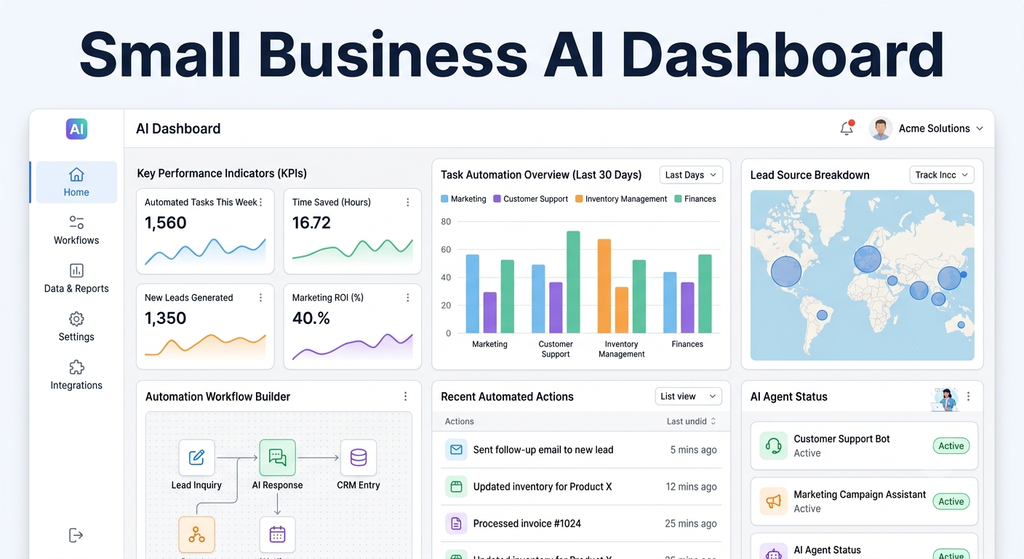
AI automation means using artificial intelligence together with software workflows to complete repetitive or information-heavy business tasks. Traditional automation generally follows fixed rules, while AI-powered systems can work with language, patterns, predictions, and large amounts of information.
For example, a traditional workflow might send the same email to every new subscriber. With AI email marketing automation, the system can help personalize the message based on available customer information, previous interactions, interests, or behavior.
Small businesses can use AI automation for:
- Customer support
- Marketing
- Email campaigns
- Lead management
- Appointment scheduling
- Data entry
- Content creation
- Social media management
- Sales follow-ups
- Reporting and analytics
- Internal business workflows
The objective is not necessarily to automate every activity. Instead, businesses should identify repetitive processes where automation can save time while maintaining quality and appropriate human oversight.
H2: Why AI email marketing automation Matters for Small Businesses
Large companies may have dedicated marketing, sales, customer service, and technology teams. Small businesses frequently have employees managing several responsibilities simultaneously.
AI automation can reduce repetitive work and allow employees to concentrate on activities requiring creativity, communication, strategy, and judgment.
For marketing teams, AI email marketing automation can be particularly valuable because email campaigns often involve several repetitive steps. A business may need to segment contacts, create messages, schedule campaigns, monitor engagement, and send follow-ups.
An automated workflow can connect these activities. For example:
Customer signs up → contact is added to the database → welcome email is sent → engagement is monitored → follow-up message is triggered → interested customer is sent to sales.
With AI email marketing automation, AI can also assist with subject-line ideas, content variations, audience segmentation, and campaign analysis.
H2: Essential AI email marketing automation Tools for Small Businesses
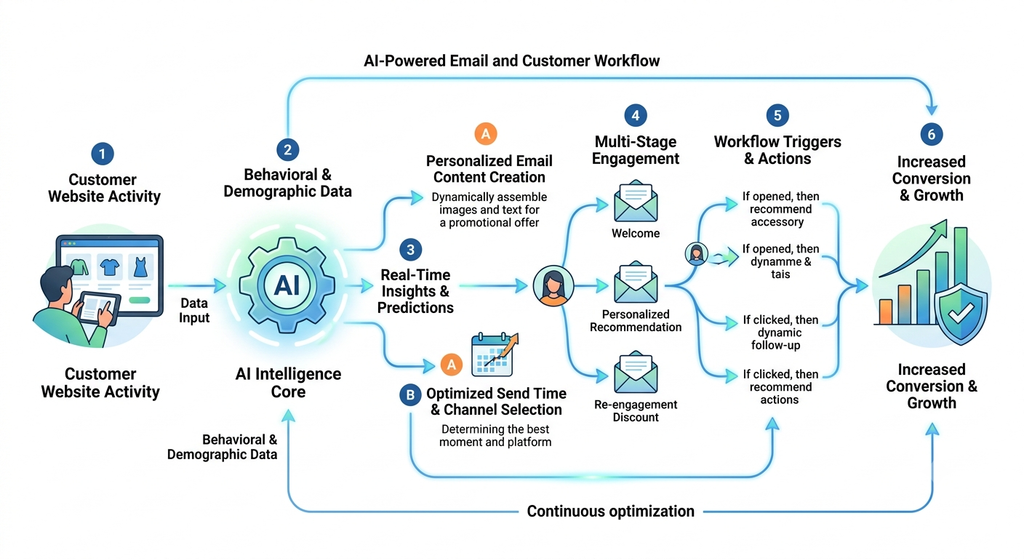
Small businesses do not necessarily need dozens of applications. A practical technology stack can combine a CRM, automation platform, email marketing system, AI assistant, and analytics tools.
H3: 1. AI-Powered Email Marketing Platforms
Email marketing platforms can help businesses create campaigns, manage subscribers, build customer journeys, and analyze campaign performance.
AI email marketing automation features may assist with personalization, content suggestions, audience segmentation, send-time optimization, and automated customer journeys.
For example, an online store could create a workflow that sends a welcome message to new subscribers, educational content to engaged customers, and a reminder to customers who have interacted with products but have not completed a purchase.
H3: 2. CRM and Sales AI email marketing automation
Customer relationship management platforms store information about leads and customers. Automation can then trigger actions based on changes in customer records.
A lead completing a contact form could automatically receive an introductory email. The sales team could receive a notification, and the lead could be assigned to an appropriate pipeline.
When combined with AI email marketing automation, CRM data can support more relevant customer communication.
H3: 3. Workflow Automation Platforms
Workflow automation platforms connect different applications. For example, a business could connect its website form, CRM, email platform, spreadsheet, and notification system.
A typical workflow might look like:
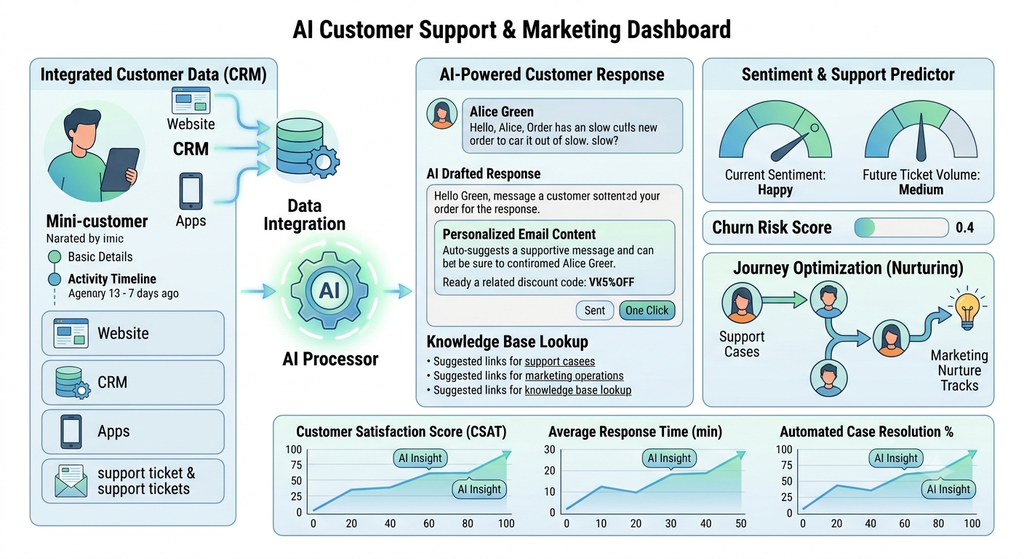
Website form → CRM → AI processing → email platform → sales notification → reporting dashboard.
This approach allows small businesses to create connected processes instead of repeatedly transferring information between applications.
H3: 4. AI Writing Assistants
AI writing assistants can help draft marketing emails, blog introductions, product descriptions, social posts, and customer communication.
For AI email marketing automation, an AI writing assistant can help create several versions of a message for different customer segments. Human review should still be used to check accuracy, tone, brand guidelines, and important claims before publication.
H3: 5. AI Analytics Tools
Analytics tools help businesses understand what is happening across their marketing and sales activities.
AI-powered analytics can identify patterns in customer behavior and campaign performance. These insights can help businesses determine which workflows deserve improvement.
For example, if customers consistently open educational emails but rarely respond to sales messages, the business could reconsider its customer journey and timing.
H2: Building an AI Automation Workflow
Before implementing AI email marketing automation, small businesses should map the existing process.
Start by identifying a repetitive task that happens frequently. Then document the steps involved and determine which steps require human judgment.
A simple implementation process includes:
- Identify a repetitive business task.
- Define the desired outcome.
- Map the current workflow.
- Select suitable automation tools.
- Connect the required applications.
- Create automation rules.
- Add AI where it provides genuine value.
- Test the workflow.
- Monitor results.
- Improve the workflow over time.
For example, a small consulting company could automate its lead nurturing process.
A visitor completes a consultation form. The information enters the CRM. AI email marketing automation then triggers a personalized introductory email. If the person engages with the email, a second educational message can be sent. If the lead requests a consultation, the sales team receives an alert.
This creates a structured customer journey without requiring an employee to manually manage every step.
H2: Real-World Use Case: AI Email Marketing Automation
One of the clearest applications is customer email communication.
Consider a small online business with hundreds or thousands of subscribers. Manually sending personalized emails to every customer would be difficult.
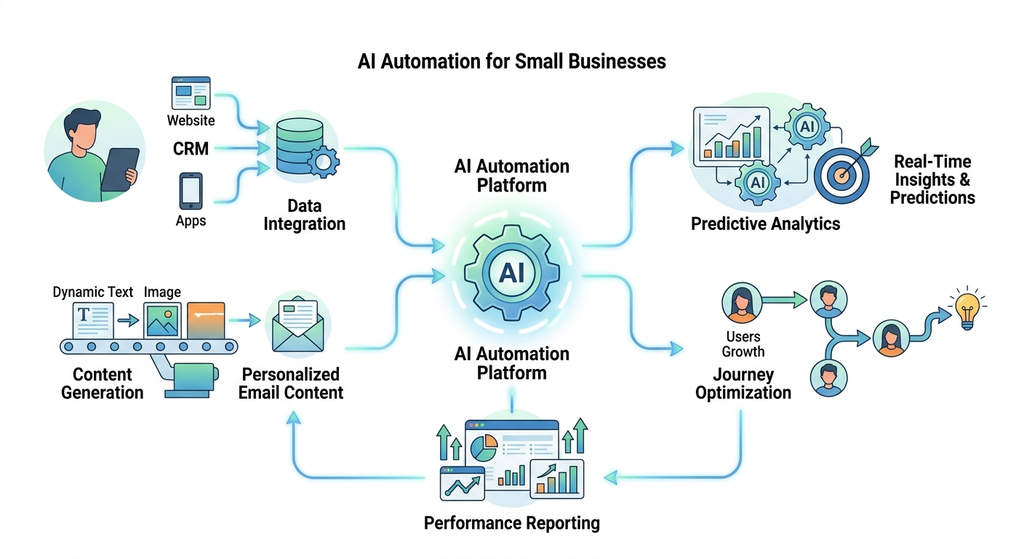
With AI email marketing automation, the company can create customer segments and automated journeys.
A basic workflow could include:
New subscriber → welcome email → educational email → product information → follow-up → customer support invitation.
AI can assist with generating content variations and analyzing customer engagement. Automation handles timing and delivery.
Another workflow could focus on existing customers. After a purchase, the customer might receive an order-related message, helpful product information, and a later feedback request.
The business can then analyze the results and adjust its workflow.
H2: Real-World Use Case: Lead Generation and Follow-Up
Lead follow-up is another area where small businesses can benefit from automation.
Imagine a local service company receiving inquiries through its website. Without automation, an employee might need to manually copy each inquiry into a spreadsheet, send a response, and remember to follow up later.
An automated system can reduce these steps.
A visitor submits a form. The CRM stores the lead. AI email marketing automation sends an appropriate introductory message. The sales team receives a notification, and a follow-up workflow can be triggered according to the customer’s interaction.
This helps create a more consistent process.
H2: Real-World Use Case: E-Commerce Customer Journeys
E-commerce businesses can use AI automation throughout the customer lifecycle.
For example, a store can create workflows for:
- New customer welcome messages
- Product education
- Order-related communication
- Customer feedback
- Product recommendations
- Customer re-engagement
- Promotional campaigns
AI email marketing automation can help organize these journeys around customer behavior rather than sending exactly the same communication to everyone.
The important principle is relevance. Businesses should avoid excessive messaging and ensure customers receive useful information.
H2: Real-World Use Case: Appointment-Based Businesses
Consultants, tutors, agencies, repair services, and other appointment-based businesses can automate communication around bookings.
A customer might receive an automated confirmation after scheduling an appointment. A reminder can follow later, and a post-appointment message can request feedback.
With AI email marketing automation, Maximized businesses can also organize follow-up campaigns for customers who have not booked another appointment.
For a small team, these workflows can reduce administrative powerful work while creating a more consistent customer experience.
H2: Real-World Use Case: Customer Support
AI automation can also assist customer support.
A business can create workflows that categorize incoming questions, route messages to the appropriate team, and provide automated responses for common requests.
For example, customers asking about business hours, basic policies, or order status may receive automated information, while complex issues can be forwarded to a human representative.
When AI email marketing automation is connected to customer support workflows, support interactions can also trigger relevant follow-up communication.
However, businesses should provide a clear path to human assistance when an automated response is insufficient.
H2: How AI Email Marketing Automation Improves Productivity
The major benefit of AI email marketing automation is reducing repetitive manual work.
Instead of repeatedly creating the same campaigns and manually checking customer actions, businesses can create reusable workflows.
Power Word Examples in Action
- Catchy Headline: Supercharge Your Sales: How Small Businesses Can Scale Revenue with Instant AI Email Automation
- Email Subject Line: Unleash 24/7 Hands-Free Email Automation for Your Business
- High-Converting CTA Button: Unlock Your AI-Powered Email System Today
For example, a welcome sequence only needs to be designed once. After that, the workflow can automatically handle new subscribers according to the rules established by the business.
This can help employees spend more time on strategy, customer relationships, product development, and other important activities.
Automation can also improve consistency. Every customer entering the same workflow can receive the appropriate communication without relying entirely on someone remembering to send it.
H2: Common Mistakes to Avoid
Although AI email marketing automation can be useful, poor implementation can create problems.
H3: Automating Everything
Not every task should be automated. Complex customer complaints, sensitive communication, and important business decisions may require human involvement.
H3: Sending Too Many Emails
Automation makes it easy to send messages frequently. However, more messages do not automatically mean better marketing.
Businesses should establish sensible communication limits and provide customers with appropriate subscription controls.
H3: Ignoring Data Quality
AI and automation depend on accurate information. Incorrect customer names, outdated contact information, or poorly organized segments can lead to poor communication.
H3: Skipping Human Review
AI-generated content should be reviewed before important campaigns are published. Human oversight helps maintain accuracy, brand consistency, and appropriate messaging.
H3: Choosing Too Many Tools
A complicated technology stack can create more problems than it solves. Start with a small number of tools and expand only when there is a clear business requirement.
H2: How to Measure AI Automation Success
Businesses should measure automation using meaningful performance indicators rather than simply counting the number of automated tasks.
For AI email marketing automation, useful metrics can include:
- Email engagement
- Click activity
- Conversion rates
- Lead response rates
- Customer retention
- Unsubscribe rates
- Time saved
- Revenue generated from campaigns
- Workflow completion rates
For broader AI automation, businesses can also measure employee productivity, processing time, customer response time, and operational costs.
The exact metrics should depend on the business objective.
H2: The Future of AI Automation for Small Businesses
AI automation is becoming increasingly accessible to smaller organizations. Businesses no longer need large technology teams to experiment with intelligent workflows.
The future of AI email marketing automation is likely to involve increasingly personalized customer journeys, improved content assistance, behavioral analysis, and deeper connections between CRM, marketing, sales, and customer-support systems.
However, successful automation will still require strategy. AI should support business goals rather than become a technology experiment without a clear purpose.
Small businesses that begin with practical use cases can gradually expand their automation systems as they understand what works.
H2: Final Thoughts
AI automation can help small businesses reduce repetitive work, organize processes, and improve customer communication. Among its many applications, AI email marketing automation provides a practical way to build consistent and personalized customer journeys.
The best approach is to start small. Identify one repetitive process, define the desired result, choose appropriate tools, build the workflow, test it, and measure the outcome.
Whether a business wants to automate lead follow-ups, customer emails, appointment reminders, support communication, or marketing campaigns, AI can become a valuable part of its workflow when implemented thoughtfully.
The goal is not to replace every human task. The goal is to allow people to spend less time on repetitive processes and more time on activities where human creativity, judgment, and relationships matter.
Add a Comment